Friday, November 6, 2009

Shusuke Kaneko: Kaiju Man


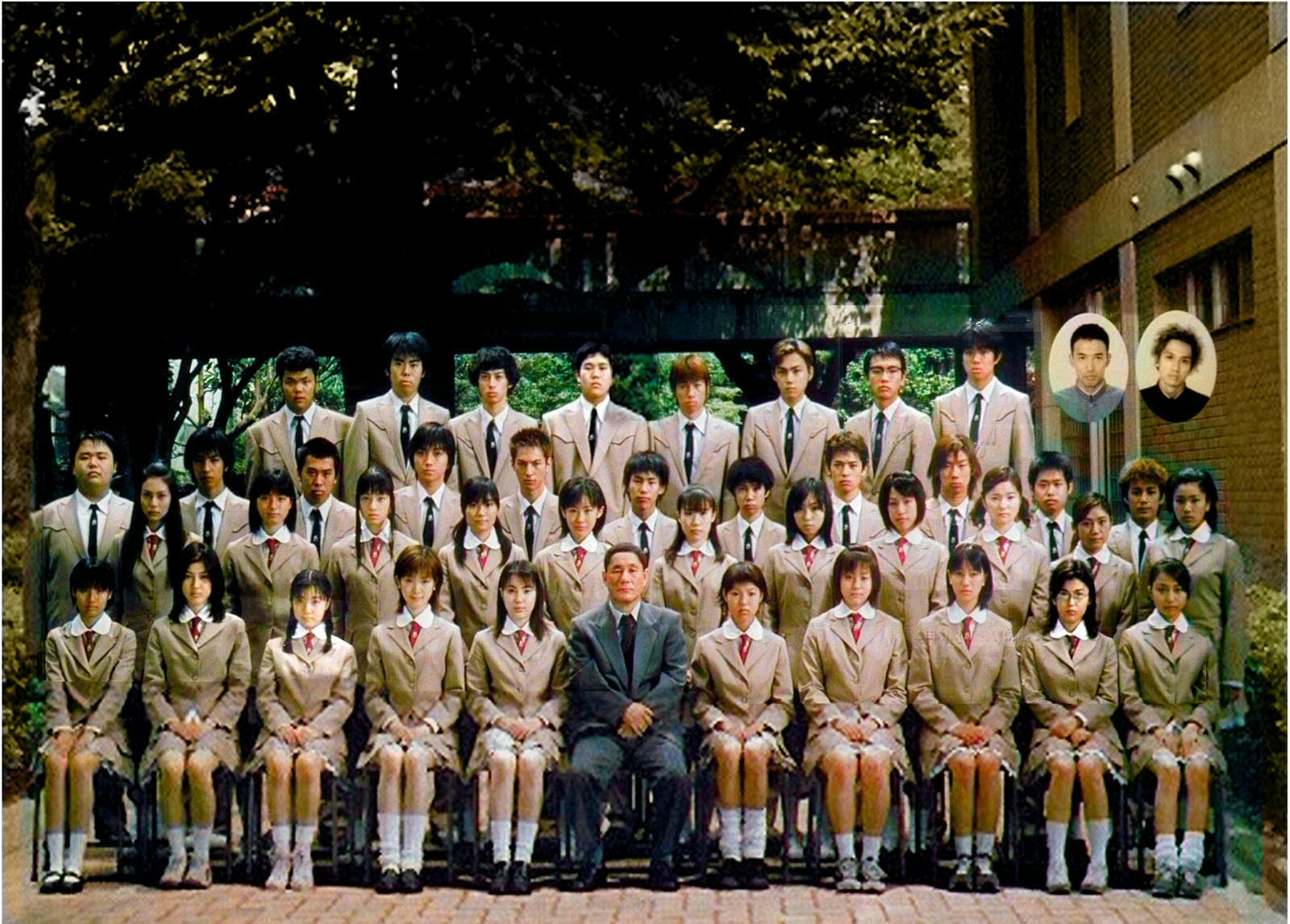
Check out Shusuke Kaneko on imdb.com and you’ll find that he’s currently involved in post-production on the movie Bakamono, starring Hiroki Narimiya (from both Nana movies and the Honey and Clover live-action TV series) and Miho Shiraishi, who previously appeared in the bizarre Calimari Wrestler (2004).

At the beginning of this year he also helmed the over-the-top rival opera singer romp Pride, starring Hikari Mitsushima – a.k.a Sayu Yagami in the Death Note movies.

Which is no coincidence, since three years ago Shusuke Kaneko directed both Death Note and its sequel Death Note: The Last Name.

The man responsible for the sequel to Ryuhei Kitamura’s Azumi popped up a decade before as one of three directors for a 1994 American/French adaptation of H. P. Lovecraft’s Necronomicon.

He then steered into kaiju (monster) territory when he directed a trilogy of movies featuring Gamera, the giant flying turtle (1995 to 1999); two years later Kaneko hit paydirt when he helmed Godzilla, Mothra and King Ghidorah: Giant Monsters All-Out Attack.

While recently the principle involved in the Ultraman reboot TV series, Ultraman Max (original Ultraman director Akio Jissoji and the great Takashi Miike were others alongside him), at the same time that the Death Note spotlight fell, Kaneko in fact started out in the 1980s as an assistant working in the roman (romance) porn industry for respected production company Nikkatsu – just like fellow directors Tatsumi Kumashiro (Woman with Red Hair) and Koreyoshi Kurahara (Antarctica).

These days, at the age of 54 and with the Death Note movies on his resume, Kaneko is one of Japan’s more in-demand film-makers and he made time in September to chat with me in an interview this month published in its entirety in Impact magazine – nicely translated to full effect by my wife Yoko.

Here's the straight Q+A version.


Why do you enjoy directing, and which part of creating movies makes you the happiest?

“I’m happy when I feel my originality and talent are alive – the times that I think other directors would never shoot like this, or they wouldn’t think that way; the moments when I know my choice is the best choice. That moment comes all of a sudden while I’m making a script, shooting, editing. If the moment becomes continuous it can be fun, though sometimes it’s not. So I can’t say which process, in general, makes me the happiest.”


I note that you are now completing postproduction of the feature Bakamono – could you tell us more about this movie?

“Yes, we’re working on that now. This movie is about a guy who lives in a local city for about a decade, from the age of 19 to 29 years old. He doesn’t have any skills – he was raised by a sweet family, so he’s a nice guy but rather stupid. He is hurt in love, becomes an alcoholic… then he become a ‘man’. This story describes his path with a bit of a poetic touch.”


How was the earlier experience of directing the Death Note movies?

“Because of my super-tight schedule, the work required lots of concentration from me. The offer came on 10 December 10, 2005, and at that time it was already planned that the first-half movie would be released in June 2006, and the rest of the story in the second part in November 2006. So shooting took place in February and March 2006. I had also committed to work on Ultraman Max for TV around the end of the year and the new year, so while making the script for Death Note, I shot Ultraman Max. It ‘s fun to think back to that busy time now.”


Had you read the original manga by Tsugumi Ohba and Takeshi Obata before doing the Death Note movies?

“Two years before I got that offer, my elementary school son brought me the first volume of the comic. At the time I thought the concept was interesting, but I didn’t imagine that that kind of thing would be made into a movie, so I didn’t read the rest of it. But straight after I received the offer to make the films, I went straight to a manga cafĂ© and read the whole series – then went to the meeting.”


Why do you think the Death Note franchise has been so successful in Japan?

“When the Internet had established itself across Japan, Death Note appeared [in 2003] and it created a realistic setting for an otherwise impossible story. The imaginative superstition – that you’ll die if you write your own name in the notebook – coincided with the phenomenon that an anonymous note on the Internet could harm a person quite physically.”


Some people argue that the Death Note stories encourages kids to be violent...

“I think it’s possible. But there’s a lot of other stuff that makes kids violent. I certainly don’t think I’m making good stuff in the educational realm.”


Could you tell us more about the Ultraman Max experience, directing with Takashi Miike and other directors?

“Tsuburaya Productions offered me a job as main director, and I was in the position of controlling the scriptwriter selection, other directors and the cast. The producer approached Mr. Miike to shoot two episodes as a guest director, so I thought he would be great for that job. My view of the Ultraman Max world was closer to that of the original Ultraman rather than science fiction; an anything-is-possible place. So I wanted the other directors work freely and I think Mr. Miike could do so in that way too.”


How did you get involved directing the Gamera movies, from Gamera: Guardian of the Universe in 1995 to Gamera 3: The Awakening of Iris in 1999?

“I can’t describe that in such short space, but I think people thought me suitable for the Gamera directing job since I had just given a presentation to the producers, Diei Motion Picture Company, on Ultra Q.” [The 1966 sci-fi/kaiju monster series was the most expensive TV series in Japan at the time.] “I wasn’t a Gamera fan when I grew up. I hadn’t exactly thought Daiei’s monster films were childish, but I liked Toho’s monster films better when I graduated from elementary school. Just before I got into adolescence, which is when I got into girls, I was also a manic fan of monster movies; at that time I was making a monster illustration book by myself. Therefore, when I was directing Gamera, I felt happy that I could revert back to my childhood.”


In 2001 you directed the wonderful Godzilla, Mothra and King Ghidorah: Giant Monsters All-Out Attack.

“There was something I quite deeply felt about that... I started with Gamera, and reached up to Godzilla. Since Toho studio was producing movies more systematically than Daiei, I could hop on that flow and make movies myself. Then again, we had more time to prepare for Gamera but there wasn’t enough time to think about Godzilla – I feel like we made that movie on impulse power. But, of course, Gozilla is charming.”


Imagine a battle between Godzilla and Mothra. Who would win, and how?

“They had fights so many times already, so please talk to Toho about that suggestion, and get them to offer me the director’s chair so I can start dreaming up ideas!”


The rest of this interview has been published in the November issue of British anime & action movie magazine Impact - see HERE for details.

Thursday, November 5, 2009

Tokyo Parasite Museum


Situated not all that far from Meguro Station, in Tokyo, is an unforgettable rejoinder to the foodstuffs unveiled elsewhere in this hack blog.

The Tokyo Parasite Museum is a trendy dating locale for young couples (no joke), and right near its entrance you get the gist of the theme: There’s a Godzilla-sized specimen of a tapeworm, 10 metres (30 feet) in length, that was extracted from some poor fool in Yokohama.

Established by a group of Japanese University parasite-specialist professors, the museum showcases some repellingly mammoth and subversively fascinating microscopic exhibits - revealing a collection of grotesque real-life freeloaders, most of ‘em uglier than those imaginary alien terrors from old sci-fi movies. Move over, Predator and James Arness.

This is the only museum in the world where you can see 300 varieties of parasites lumped together in specimen jars, and the notes make you aware that many of them are naturally ingested with… food.

It’s enough to put you off the delights of sushi. Well, almost, anyway.

Mmm... sushi.

Saturday, October 31, 2009

Luke's Anger 'Several Sizes Too Big'


LUKE'S ANGER
"SEVERAL SIZES TOO BIG"
[IF099]


Brilliant, lovely stuff from one of our current fave British musos, a regular on Kid606's Tigerbass label and the helmsman of IF? preferred label Bonus Round - as well as the guy who slew 'em at the last BLOC party and who's really showing how to redefine electronica at the mo'.

1. Several Sizes Too Big (4:20)
2. Critical Error (4:41)
3. Sound Clash (5:22)
4. Project Perk (4:12)


SAMPLE SOUNDS + INFO + DOWNLOADABLE HERE


Cool cover by Hollie Etheridge.

Monday, October 26, 2009

Free Muzak Mix to Download


This is now up on the illustrious Fun in the Murky site:

"It's been a wee while since Andrez last contributed to Bleep. I guess he got tired of writing all of those articles for FitM that he's been doing lately. I mean, just because the fellow can string a few words together he thinks it means he's exempt from stringing records together? Ha ha! Of course not! Enjoy the mix he's put together."

Download the free 60 minute mix HERE.

Track-list:


1. Little Nobody - Shuttlecock
2. Donk Boys - The By-Blow
3. Luke's Anger - Work That Body
4. Ant Orange - Popo Lead 1 sample
5. Little Nobody - Compulsion (E383 remix)
6. Alex Cortex - Stingray Split
7. Little Nobody feat. Robo*Brazileira - Robota (Koda remix)
8. Little Nobody - Compulsion
9. Little Nobody - Metropolis How?
10. Psyborg-9 - Your Soul Is Mine (Bitch Shift remix)
11. Koda - Tilb
12. Koda - Indix (Bitch Shift remix)
13. Little Nobody - Compulsion
14. Jungle Taitei - Taitei Drums (DJ Warp remix)
15. Ein Kleiner Schelm vs. Little Nobody - Bulletproof (Live mix)
16. Little Nobody feat. Robo*Brazileira - Robota (Steve Stoll remix)
17. Enclave - Ironyism (Cut Phobic remix)
18. Cristian Vogel - Cara De Poto
19. Jungle Taitei - Taitei Drums (DJ Hi-Shock remix)
20. Jamie Lidell - Freely Freekin
21. Funk Gadget - Blah Blah
22. Son Of Zev - TOMMS (Wolfgang Klein remix)
23. Donk Boys - The By-Blow
24. Little Nobody - Metropolis How?
25. Little Nobody feat. Robo*Brazileira - Robota (Jammin' Unit remix)
26. DJ Fodder - Cocaine Speaking (Little Nobody remix)
27. Little Nobody - Compulsion (Luke's Anger remix)
28. Ben Pest - Tiny Beginnings
29. Donk Boys - I Saw the Sine
30. Little Nobody feat. Robo*Brazileira - Robota (Prekids remix)
31. Koda - Tilb
32. Hexstatic - Wouldn't it Be House?
33. Luke's Anger - Several Sizes 2 Big
34. Luke's Anger - Project Perk
35. Little Nobody - Whiskers
36. Little Nobody - 100 Years of Vicissitude
37. Luke's Anger - Sound Clash
38. Luke's Anger - Critical Error
39. Funk Gadget - Noise Quirks
40. Little Nobody feat. Mike Vendetti - The Black Bird

Monday, October 5, 2009

The Last Techno Party Ever... As IF?


What, me self-indulgent? Never! But I'm about to head back to my hometown (Melbourne) for a holiday, and what better than to add a big underground techno party into the mix?

Even better having 7 live acts dominating proceedings, with DJs supporting. Yum. Full details on the flier. If you happen to be in Melbourne (Australia, not Florida), get'cha crap booty on and faux boogie.

Or just sit down and kick your feet up, which is what I'll be doing with my mostly-recovered busted foot.

Friday, October 2, 2009

Kabuki-za Theater


Boasting a lot of greasepaint, big hair, and some frightening, exaggerated facial expressions – not to mention specific choreography and minimal music to score the whole caboodle – it’s no wonder that some young Japanese think of kabuki as an old fashioned, unintelligible art form that needs a good dust-down after four centuries on the go – just like Shakespeare.

Yet it’s remained remarkably durable, and has in fact made a comeback in recent years that culminated in its nomination by UNESCO in 2005 as one of the “43 Masterpieces of the Oral and Intangible Heritage of Humanity”.

Here in Tokyo, kabuki performances take place on a daily basis at the Kabuki-za theater in Ginza, a historic location first built in 1889 but consecutively destroyed by fire, earthquake and Allied bombing.

The current building, a reconstruction built after WWII, has been rendered in a Japanese baroque style that looks gorgeous, and is itself another reason to attend one of these vital Japanese cultural performances.

Word has it that this building too is fated to be destroyed, next time by a wrecking ball in the next year or so.

Sunday, September 27, 2009

Sake of the Day


“For me, namazake is the best kind to drink, and I’m so into Kikusui.”

So declares apprentice manga artist Eiko Magami as she refers to Funaguchi Kikusui Ichibanshibori, a canned, non-pasteurized and undiluted nihonshu.

Turns out that 99% of sake on the market has been pasteurized twice - once straight after brewing, and another time after a decent maturation period or just prior to shipping.

Namazake, like a fine wine, has not; it continues to age in the can.

“Kikusui was released in 1972, and it was the first attempt at this kind of sake at the time,” advises Ryoko Takano at Kikusui Sake Co., Ltd., which takes its name from a Noh song concerning a 700-year-old mountain hermit, and is based in Shibata in Niigata. “This is our long-time best seller because of its fresh fragrance derived from a first-pressed and non-pasteurized method, and its full-body taste derived from the undiluted process.”

The rest of this rather wayward (and much longer) homage to one of my favourite Japanese brews is going to be published through Geek Monthly in its November issue, with feedback from DJ/producer Ken Ishii, anime writer/director Satoshi Kon, and Death Note director Shusuke Kaneko - plus an extended mix of the story will be published in book-form next year. I kid you not.

Kampai.