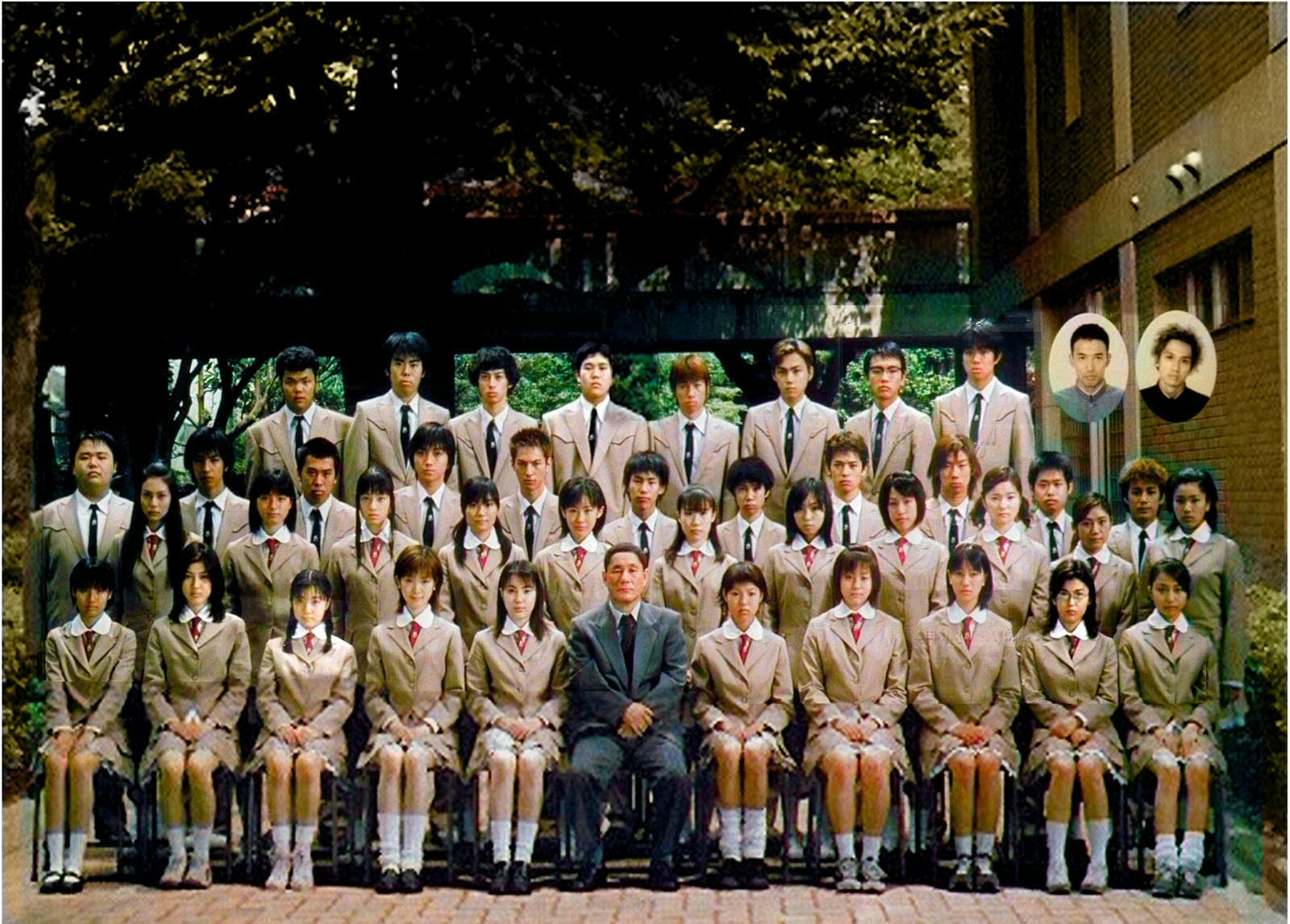
You've likely already heard the rumours — forget what you think you know about The Hunger Games franchise since it's pretty darned blatantly sourced from better film Battle Royale (2000).
Thing is, that's in turn based on Kōshun Takami's 1999 novel, and there's a manga series of Battle Royale that was published from 2000 to 2005, illustrated by Masayuki Taguchi.
But let's get back to the cinematic outing.
This violent, often wildly hilarious — and disturbing — gem is p'raps
not quite so obscure now, thirteen years on, as when it was first
released in Japan.
Battle Royale would've made a far more fitting obituary for its director Kinji Fukasaku
rather than its lesser sequel three years later — which in fact his son
Kenta polished off after the director's death at age 72.
You certainly couldn’t take style, content and inspiration any further a
field from Fukasaku, Sr.'s earlier adventure schlock-romp Legend Of 8 Samurai.
So clear your frazzled Hunger Games brain.
It’s a not-too-distant future.
Japan is again a fascist state. An
arbitrarily-chosen bus full of high school kids are knocked out with
sleeping gas, kidnapped, then shipped on to an isolated island — where
they’re informed by their embittered former teacher Kitano ('Beat' Takeshi Kitano) that the only way they will leave said island is by killing all their classmates — or by ending up in a body-bag themselves.
In order to enforce this mandate, each student is shackled with an exploding collar, à la Wedlock,
and Kitano punctuates the students’ plight with a well-aimed penknife
to one of the girl’s foreheads, thereby launching a battle for
self-preservation.
The last time I saw him (aside from in recurrent TV advertising here in Japan) was in the 2008 reshooting of Akira Kurosawa’s 1958 epic Kakushi toride no san akunin (The Hidden Fortress) – the movie that George Lucas has admitted made such a huge impression on the shooting script for Star Wars Episode IV: A New Hope.
As a samurai, General Makabe (in another role played by the late, great Toshiro Mifune) turns out to be perhaps the most fearless and honourable man alive – as well as one of the more charismatic and inspiring. He’s got that rousing leader quality, the sort Russell Crowe delivered in Gladiator, Edward James Olmos brandishes on Battlestar Galactica, and King Hal throws about in the pages of Shakespeare’s Henry V.
It’s also the kind you just didn’t get at all from Orlando Bloom in Kingdom Of Heaven nor Yuji Oda in the 2007 remake of another Kurosawa classic, Tsubaki Sanjuro.
In Star Wars, General Makabe ended up necessarily spliced into the two characters handled by Harrison Ford (as Han Solo) and Alec Guiness (Obi-Wan Kenobi).
And while the original Kurosawa title literally translates as “The Three Villains of the Hidden Fortress”, any mention of villainy and/or camouflaged bunkers were eschewed in the title of the lacklustre 2008 incarnation with Hiroshi Abe, which opted instead for The Last Princess.
Possibly they had Leia more in mind. “With a good script, a good director can produce a masterpiece,” Kurosawa, who also co-wrote the story for The Hidden Fortress, once said.
“With the same script, a mediocre director can produce a passable film.”
In the driving seat this just-passable second time round (or the third, if you want to include Star Wars) was Shinji Higuchi, a man respected for his skills with SFX and story boarding rather than any panache as a director.
Higuchi previously helmed Lorelei (2005) and Japan Sinks the following year; his choice for the role originally played by Mifune and the one that inspired Han Solo?
Former model and regular TV actor Abe – himself a capable individual who unfortunately, in this case, lacked the raw charisma of either Mifune or Ford in their prime.
But as I mentioned I do dig the man's work, in everything from his TV activities to Godzilla 2000 (ゴジラ2000 ミレニアム Gojira ni-sen mireniamu, actually made in 1999).
And his best role to date has been his cynical physics professor, Jiro Uedain, out to debunk things supernatural in the recurring TV series and cinema incarnations of the surreal Trick.
It's witty, pokes fun at a lot of other more dramatic TV programs and movies, has some hilarious recurring and cameo characters, and co-stars the sublime Yukie Nakama... as the hokey failed magician Naoko Yamada.
So the good news is that there's a new Trick movie upcoming in May (the release date is 8th May 2010), starring Abe, Nakama and an array of other suitably oddball characters.
It's called Gekijoban Trick: Reinouryokusha Battle Royale and is directed by Yukihiko Tsutsumi, who did the recent 20th Century Boys movies.
Perhaps not quite so internationally obscure now - nine years on - as it was when it was first released in Japan, Battle Royale would have made a far more fitting final movie for director Kinji Fukasaku instead of its lesser sequel three years later... which in fact his son Kenta polished off after the director's death at age 72.
You certainly couldn’t take style, content and inspiration any further a field from Fukasaku senior's earlier action-adventure romp Legend Of 8 Samurai, nattered about in this blog two weeks ago.
So clear your frazzled silly-season brain. It’s a not-too-distant future. Japan is again a fascist state. An arbitrarily-chosen bus full of high school kids are knocked out with sleeping gas, kidnapped, then shipped on to an isolated island - where they’re informed by their embittered former teacher Kitano ('Beat' Takeshi Kitano) that the only way they will leave said island is by killing all their classmates – or by ending up in a body-bag themselves.
In order to enforce this mandate, each student is shackled with an exploding collar, à la Wedlock, and Kitano punctuates the students’ plight with a well-aimed penknife to one of the girl’s foreheads, thereby launching a battle for self-preservation.
Shuja (Tatsuya Fujiwara, more recently the star in the live-action Death Note franchise) and Noriko (Aki Maeda; she’s appeared in both Gamera and Godzilla movies, did the voice of Yuki in the Studio Ghibli anime The Cat Returns, and teamed up last year with Kiichi Nakai in Samurai Gangsters) team up, then are later aided and abetted by mysterious transfer student Kawada (Taro Yamamoto, who appeared in Seijun Suzuki's musical romp Princess Raccoon (2005), with Hiroko Yakushimaru from Legend Of 8 Samurai).
There’re some hilarious acting histrionics and amateur execution techniques along the way, and the true stand-outs are Takako (played by Chiaki Kuriyama, a.k.a. Gogo Yubari in Kill Bill: Vol. 1), Yuko Miyamura (who does the hyperactive and chillingly genki Training Video Girl, and previously voiced Asuka Langley Sohryu in the anime series Neon Genesis Evangelion) and – of course - Takeshi Kitano.
While he previously popped up in a not-so-memorable English language role in the Keanu Reeves vehicle Johnny Mnemonic (1995), Kitano was outstanding in his own movies Sonatine (1993), Hana-bi (1997), and Zatoichi (2003). Here the actor underpins the rancorous teacher - with a 'pen' chance for revenge - with a whimsical ease and blasé humour that’s gloriously disturbing.