Recently, I've been doing my best to mimic a literary ostrich since I've
had my head buried deep inside assembly of the next novel.
Trouble is I have trouble picturing a big bird with a hardback and a pair of spectacles, wrapped in Harris tweed.
And I say assembly, because this brute not only deconstructs 1930s
detective noir/pulp and 1960s Marvel comic book lore, but renovates them
together as a conjoined tome over 100,000 words in length — stitched
together by 35 images from 28 artists.
It's the way comic books, after all, work in the real world.
Bryan Hitch's perception of Captain America in 2009 was far different from Jim Steranko's in 1969. Then compare and contrast John Buscema's chunky-thug idea of Conan the
Barbarian in 1980 with the lithe, laddish figure originally put out by
Barry (Windsor) Smith a decade earlier in 1970.
But now I'm geeky nitpicking. If I haven't lost you already, I swear
I'll try harder, there are some pretty pictures still to come, and a
bunch of other people take the verbal reins.
For now, suffice to say, this train of thought (the wayward one about
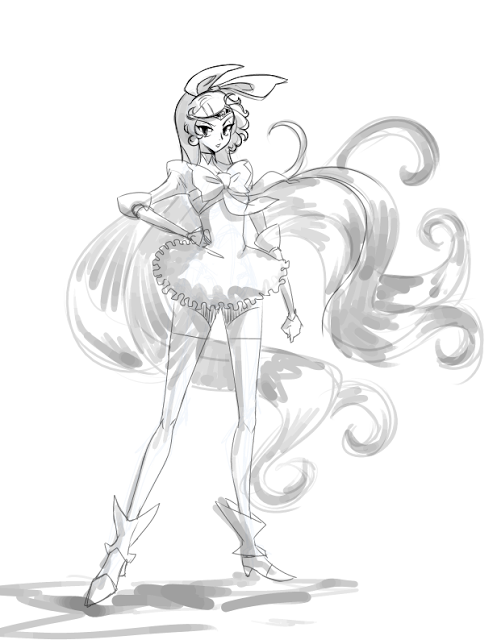
comic book art) inspired me to ask artists from Australia (Paul Mason), the UK (Harvey Finch and Andrew Chiu — see picture at right), Italy (Giovanni Ballati), Russia (Saint Yak), Spain (Javier 'JG' Miranda and Carlos Gomez), Canada (Fred Rambaud), Mexico (Rodolfo Reyes), Chile (Juan Andres Saavedra — see picture above), the Philippines (Hannah Buena) and Argentina (Maan House),
amongst others in Japan and America, to get involved drawing characters
and events from the book — and then let their hair down for a
rambunctious tête-à-tête together here.
All in all?
Putting together the novel has been like taking Lego and Meccano and
making the pieces function together as a futuristic-retro superhero romp
that mixes and matches 1930s Art Deco architectural lines with the
gung-ho Soviet formalist propaganda style, twisted into '60s pop art
sentiment and the huge influence of Jack Kirby.
Anyway, Who is Killing the Great Capes of Heropa?will be
published via Perfect Edge Books some time around September, but what
I'd like to share with you over the next couple of months of this column
are the insights and opinions of some of the fascinating, talented and
truly cool visual artists I've had the opportunity to touch base with —
while attempting to keep the bulk of these within Flash in Japan's obvious perimeters: focused on, well, the Japanese archipelago.
If interested, you can read Part 1 of this interview @FORCES OF GEEK.
This week my new novel surfaced on Amazon USA, and will be out shortly via Amazon UK and Amazon Japan.
After the big earthquake and tsunami in the Tōhoku region north of
Tokyo last year, I felt like I very much wanted to give something back
to Japan, my home for the past 11 years – a place that’s equal parts
inspiring and puzzling, a fascinating collusion of kitsch and cool, with
a history ten times longer than that of my home town, Melbourne.
Some of the original notes did make it through to the final version,
but at least 98 percent was written between September 2011, and April
2012 – and the tone is completely different.
The novel was swayed as much by family (my late grandfather Les, my
wife Yoko and my six-year-old daughter Cocoa figured significantly in
its composition) as it is by my two ‘home’ towns of Tokyo and Melbourne.
Aside the essential story of identical twin geisha, war, death and
saké, other things weighed in on the mix and I’ve decided to outline
some of these here
– as they deserve all the kudos they can get – so, if you’re curious at
all, read on at the website of esteemed noir/crime/mystery
reviewer/journalist Elizabeth A. White.
Yep, it's now confirmed – my second novel One Hundred Years of Vicissitude has just been published and is available as a paperback through new imprint Perfect Edge Books.
The novel is available here via Amazon USA – only $12 @ the moment (a $6 discount) in case anyone is… er… vaguely curious.
The Kindle version isn’t yet available, and orders through Amazon UK
and Amazon Japan take a little longer. Still, friends of mine in
Scotland and San Francisco already have a copy – though I haven’t seen
one yet.
What’s the synopsis?
Roughly-speaking, this is the story of identical twin centenarians born on
the first day of the Great Depression, one of whom loathes the other;
it’s a purgatorial tour through twentieth-century Japanese history, with
a ghostly geisha who has seen it all as a guide and a corrupt
millionaire as her reluctant companion. Thrown into the milieu are saké,
B-29s, Lewis Carroll, Sir Thomas Malory, Melbourne, The Wizard of Oz, and a dirigible – along with the allusion that Red Riding Hood might just be involved…
Some of the action also takes place in Melbourne as this is 5% a sequel/prequel to Tobacco-Stained Mountain Goat, which is actually available as a free PDF/epub.
Anyway, if you're bored, take a look-see. And the pretentious-sounding title is tongue-in-cheek, fear not...
Last weekend — after nearly driving myself to madness — I finished off my second novel (as I crowed about in undignified fashion below!) and on Tuesday, signed it to a new, rather cool publisher called Perfect Edge Books.
Yep, it goes without saying that I’m still over-the-moon at the present time, if somewhat exhausted, and to celebrate I quaffed a little saké.
Just a smidgeon, I promise.
Which brings me in a celebratory mood to this month’s Flash in Japan over @ Forces of Geek, and thereby to one of my favourite Japanese myths - which also revolves around saké, as all the good ones do.
I actually did the research on this subject a few years back, for an article on nihonshu (saké) in the pages of the late, lamented magazine Geek Monthly.
That was how I stumbled upon the tale of a monster with a taste for the hard stuff, especially rice wine.
In my new novel, One Hundred Years of Vicissitude, I decided to nick some bits of my old research and stick them into the story, albeit padded out with dialogue, and (hopefully) a bit more fun.
The monster myth was one of them.
So, let’s jump straight into the unedited, raw manuscript I just finished - there might be a typo or two at this stage.
It's now been over three weeks since the now so-called Tōhoku earthquake and tsunami. That's what it's called on Wikipedia, and it's funny how they create media-friendly monikers for these things.
It's like the ironically named Great Kantō earthquake that hit Tokyo in 1923. It was only great in terms of the number of people it killed (over 100,000).
It's now spring in this city, and the cherry blossoms are beginning to unfurl. Usually at this time of year millions of people would start to unravel their mats in crammed public spaces for the hanami – literally “flower viewing”.
Japan's famous for it.
There’s an ethereal quality to the canopy of subtle pink plumage that surrounds you in leafy places in most parts of the country, and the petals drifting on the breeze is like something spun from the reel of a classic Japanese movie... which is, well, just what you’ve probably seen, in anything from the whimsical musical romp of Seijun Suzuki’s Princess Raccoon (2005) to the dramatic demise of Ken Watanabe’s character in The Last Samurai (2003). They're also stunningly used in Makoto Shinkai's anime 5 Centimetres Per Second (2007).
It’s a remarkable sight quite unlike anything you will have encountered anywhere else in the world. While there may be the odd cherry tree that sticks out like a sore thumb in front yards from Washington D.C. to Melbourne, here in Japan these woody perennials are cultivated, pruned and spaced to perfection.
What makes the seasonal phenomenon even more special is the fleeting nature of the blossoms themselves, prompting the Japanese to use them as a metaphor for life and its brevity.
Which brings us back full circle to the Tōhoku earthquake on March 11, and the continuing woes at the Fukushima nuclear reactors.
Around 25,000 people are assumed to have been killed across 18 prefectures to the north and north-east of Tokyo, while hundreds of thousands are homeless, without basic essentials like water and electricity.
TEPCO, the people who run the nuclear power plants, have put on a carefully orchestrated stage show of ineptitude, and according to some reports may be endangering the lives of their rank-and-file staff by sending them into the reactors to fix the job that management stuffed up in the first place.
Crocodile tears from TEPCO spokesman and head honchos on the TV just don't cut it. I think the entire board of directors should be rounded up and sent in to Fukushima to replace the workers, and try to fix the plants themselves.
Meanwhile we're collectively treading water, waiting to see what happens.
Of course we hope for the best, and in my case I occasionally pray to an empty mead hall of Norse gods that the nuclear crisis will soon be a thing of the past. But no one seems quite sure what will transpire.
Most people here are dealing with it regardless, and going on with their lives in the best way possible.
There have been exceptions - like one of the talented artists on my old record label, who seems to have embarked upon a sad descent into a petty, self-centred, money-grabbing kind of madness since the crisis began, and I've lost a mate as a result - but I guess people deal with the subliminal stress in different ways.
Me? I really miss my two girls, who have been down with the in-laws in Fukuoka for two-and-a-half weeks now, until this thing blows over (er... poor choice of words) or is resolved, and we know more about the radiation issue in Tokyo. Having a five-year-old daughter makes things a little more complicated as my wife and I are far more worried about her future health than our own.
Every day I wake up in an empty apartment and go through the somewhat surreal notions of going through life and working like nothing's changed, yet in a subtle sense everything has. As I say - surreal.
And now it's spring, the cherry blossoms are on their way, and I think everyone's wondering the same thing: Is it appropriate to just let our hair down and celebrate, with all that's happened recently and that which continues to unfold up north?
Why am I even bothering to write about this here? Isn't it so damned trivial in the grand scheme of things?
To be honest I haven't got the faintest idea, but I find myself beginning to believe that to celebrate would be some kind of collective catharsis. Perhaps not partying quite so hard - in normal circumstances hanami banquets often stretch from daytime into the night (when the name of the jaunt is changed to yozakura, or night sakura), and lanterns dangle all about for people to continue drinking and warble prolific - but all the same sitting with friends, having a drink or two, and just plain celebrating the here and now could be a godsend.
After all life, as it turns out, can be as fleeting and transient as the cherry blossoms themselves, which often bloom and fall in the same week.
Besides, I'm going to throw in my favourite (anonymous) haiku here. When it's hanami season you need sake, and the two combined are part of what makes Japan truly special - especially at times of adversity like these (currently) are:
I'm still reeling and coming to terms with the news that anime filmmaker, screenwriter and manga-ka Satoshi Kon (今 敏), passed away on August 24 after a struggle with pancreatic cancer.
He was just 46 years of age, and therefore only a year older than myself.
But the list of Kon's achievements is a staggering one, and for me he was one of Japan's three leading anime directors, right up there with Mamoru Oshii (Ghost in the Shell) and Hayao Miyazaki (Spirited Away).
After all Kon - a true auteur - was responsible for the superb anime movies Perfect Blue (1998), Millennium Actress (2001) and Paprika (2006), along with the TV series Paranoia Agent.
Millennium Actress remains my favourite Kon movie.
It's as heart-wrenching as it is invigorating - and combines drama with tragedy, comedy with historical fancy, moments of action and violence with a piquant sense of whimsy.
The story itself, on the surface, is deceptively simple.
A film crew set out to make documentary on a reclusive, elderly actress named Chiyoko Fujiwara - but what follows is a blurring of reality, a tectonic, unpredictable shift in time-lines, and a haphazard association with the plot lines in the old movies that made Fujiwara famous.
Add to this the actress’ long-time unrequited love, and an equally lengthy secret crush felt by the documentary crew’s director, the devastation of Japan in World War 2, samurai battles, vindictive secret police, and rocket ship exploration – all of it somehow tied together beautifully by Kon – and you have yourself an anime masterpiece.
The influences themselves are rich enough to dwell upon – from Akira Kurosawa’s Throne of Blood (1957), which rewrote Shakespeare’s Macbeth in a samurai context, to the real-life actress Setsuko Hara, famous from the 1940s to the ‘60s in movies by Kurosawa (The Idiot, 1951) and Yasujiro Ozu (Tokyo Story, 1953), who suddenly withdrew from public life in 1963, the same year that Ozu died, and has only been viewed once or twice in the ensuing 45 years by the prying Japanese media. Meanwhile, Kon's Paprika is arguably to Inception precisely what Oshii's Ghost in the Shell was to The Matrix.
Late last year I had the chance to interview Kon-sama and the resulting article was published in the January 2010 issue of Impact magazine over in the UK. I forwarded on a copy of the article to him and he e-mailed me back in January to say "It will be good for my English studying. Thank you."
Which was typical of Satoshi Kon in my all-too-brief experience of dealing with a man who turned out to be humourous, genial, thoughtful, thought-provoking, and fun - he even contributed to my long-winded piece on sake.
So, as one struggling way to pass on my own personal kudos, here is much of that interview, promised in this blog a few months back. The insights are at times inspiring as much as enlightening regarding his essential body of work.
INTERVIEW - OCTOBER 2009
Why do you enjoy directing movies, and which part of creating them makes you the happiest?
“I find joy in the entire film-making process – I really enjoy every single moment along the way. From assembling the script to begin establishing the world view, then on into character designs and art setting, story boarding, and collaboration work with lots of staff for the actual drawing and background art – this all makes for a stimulating experience, and there’s so much stuff I want to do in editing or in the acoustic work, too. Whatever the output, be it a sentence, a picture, or a sound, concreting the idea together is someone who is, after all, nothing but an anime fan.
“After the movie is completed, visuals creation or interview to advertise is a very important mission too; these are great opportunities to look back at the way I directed and what kind of movie I ended up with. In the course of film making, there are actually no jobs I don’t appreciate – though of course it’s not fun to give up or compromise an idea for the budget or tight schedule, I believe those decisions are going to be beneficial for the entire movie world, so I never think those are negative things either. A strategic withdrawal is sometimes necessary, and it’s an important decision to make.
“Among these fun-filled processes, I prefer doing the storyboard.
"When I’m doing this, I really feel like I’m ‘making the movie’. Even if they’re the still images, the story is visualized by connecting pictures, so it’s like letting the actors act, shoot them, and edit them – all on paper.
"Everything about my film making is on the storyboard.
“I was originally a manga artist – so therefore, controlling the storyboard is really easy for me since the style of story boarding is like doing comics. Manga artists are good at drawing tiny pictures within the frames; the only major difference between storyboarding and a comic is the fact that the storyboard is the blueprint to move characters, and the time flow, divided by 24 frames per second, becomes the important factor.”
How would you personally describe the kind of movies you make?
“It’s difficult to answer to that kind of wide-ranging question!” [laughs]
“But if I do dare to put into words the movies I have been directed, it would be ‘fantasy based on a world that has reality’. To only describe the real world is not enough, and only fantasy is far too sweet to have. Therefore, I’ve wanted to make something that has reality in its foundations, then take off from there and fly into the domain called fantasy. Quite basically this mentality hasn’t changed since I was drawing manga, before making anime. I can’t say for sure that this philosphy will continue into the future, however.”
It's been said that "Satoshi Kon's forte [speciality] is in the surreal interaction of reality and dreams - which often drift into nightmares." Would you agree?
“Of course. The interaction of reality and dreams is a motif I still have interest in, and I keep bringing it back into my work. Since my debut Perfect Blue [1998] got attention for that motif, I intentionally used it as a central focal point in Millennium Actress, Paprika, and so on. I think the way in which I’ve handled this, along with my workmanship skills, have got better and better after using this motif several times.
“However, it’s not healthy to keep using the same motif again and again, neither for the audience nor creators – even when utilized in a different context. So I think it’s better for me to steer away from ‘the surreal interaction of reality and dreams’ for a while, though I’m still interested in the theme.”
You did your first script for Magnetic Rose, directed by Koji Morimoto and based on the work of Katsuhiro Otomo, in 1995. How was that experience for you?
"Magnetic Rose became the movie that gave me the first opportunity to use the ‘interaction of reality and dreams’ concept, but at that point I wasn’t sure how to place and blend reality and dreams, so my technique and workmanship were simple. Still, there's no doubt the experience with that script led to the common characteristics of my work, and that became the big turning point in my creation history. I was in charge of script, art setting, and layout. I liked the story and visual factor, though at the same time I often felt the differences between my interpretation and the producers'. But I can say that it made me interested in the directing job so it certainly was memorable for me."
Millennium Actress (2001) is a wonderful movie that manages to reflect Japan's changes in the years before World War 2, and since then. Was this your intention?
"The answer can be yes and no; it depends to which ‘intention’ belongs. Originally the idea of Millennium Actress was for the main character, the actress, to run through her subjective time – which in reality is a play within a play – and for that we wanted to describe an eventful life story over a lengthy period.
“Then, while padding plot lines and thinking about the script, the idea dawned on me to insert a Japanese film history aspect and integrate the actress character’s development; it became a movie you can interpret in multiple layers. The notion of change in Japan itself filtered out during the film making process, which I hadn’t thought about in the beginning. I wouldn’t say that I became familiar with history through making this movie, but Millennium Actress is a special film which gave me the opportunity to rethink the relationship between me and my country.”
In Millennium Actress reality and unreality become blurred, and it becomes a story within a story. Could you tell us more about the development of the script?
“The plan for Millennium Actress got started by a call from a producer who’d just watched Perfect Blue.
“I began by thinking about a story which has the structure of ‘trick’ paintings, since the producer told me that he wanted to make a movie that was as much like a ‘trick’ painting as Perfect Blue apparently was for him. The first inkling of an idea was a sentence, and it was this: ‘Once upon a time an old actress talks about her life, but her memory is scrambled, mixed with various roles she acted in, and together this creates a dramatic story.’ I made a rough plot from this first memo.”
It's said that the character of Chiyoko Fujiwara is loosely based upon real-life actresses Setsuko Hara and Hideko Takamine. Is this true? What other influences shaped her character?
“As the image model, as you say, Setsuko Hara and Hideko Takamine are the actresses who represented the postwar movies, but I was influenced by a lot of other actresses too. In Chiyoko’s background, the actress who retires all of the sudden is sourced from Setsuko Hara, while the bright smile in the chaos after the war comes from Hideko Takamine’s image. However, those influences are more about the ‘appearance’ images I borrowed; to create Chiyoko’s personality, I didn’t refer to any real actress. Of course, I was going through Ms. Takamine’s bio and many actresses’ interviews, so probably there might be parts I included from those without being conscious about it.”
And then there’s Paprika, the movie Kon released through Madhouse in 2006. The opening minutes of the movie introduce the pivotal character of police detective Konakawa and his recurring nightmare – which revolves around the spliced-and-looped discovery of a homicide victim. You then undercut this traumatic vignette with references to a roll call of Hollywood standards, like Cecil B. DeMille's The Greatest Show on Earth, Tarzan the Ape Man, Roman Holiday, and Hitchcock's Strangers on a Train, all rolled up into one sweet dream sequence. Which foreign film directors have most influenced you over the years, and why so?
“It’s a difficult question. John Ford, Billy Wilder, Sir Alfred Joseph Hitchcock, Stanley Kubrick, George Roy Hill, Robert Altman – it’s endless. I can’t limit myself to the one. For dream sequences and the like Terry Gilliam stimulated me, especially in the beginning of Time Bandits, in Brazil, and in The Adventures of Baron Munchausen. These are my favourite movies. For the technique to connect different times and space, I was hugely influenced by George Roy Hill’s version of Slaughterhouse-Five.
"However, for the basic idea of the movie, I think I learned more from Japanese director Akira Kurosawa than overseas directors. I don’t have nerve to say I’m influenced by him, since I just learned, but I often read Akira Kurosawa’s director interviews or his crew’s interviews while making my own movies.
“Of course there are important directors like Yasujiro Ono, Kenji Mizoguchi, Keisuke Kinoshita, Masaki Kobayashi, Kihachi Okamoto, Kon Ichikawa, et cetera, but there is no one like Akira Kurosawa – who produced numerous masterpieces and who defined such strength of image. People can identify his work at a glance. Not only the acting or look, but the theme music, art, camera angles, the light, the tools or cloths... everything.”
ADDENDUM
At the time of our chat Kon was gearing up for the release of his long-awaited next anime movie Yume Miru Kikai (The Dreaming Machine), again through Studio Madhouse.
"This is my own original story - therefore different from my previous work," Kon advised at the time.
"While I was developing the script, I heard about a movie called WALL·E... and I got a little nervous that it might be similar to mine. I can't tell you how relieved I was when I learned that the two stories were totally different," he laughed.
"In The Dreaming Machine, only robots are there. I want the audience to enjoy the adventures of robots who survived even after their parents - human beings - had become extinct. After Paprika, I ended up taking a vacation for over a year, so we've just started development on this. You can see this movie in 2011."
I'm not sure what Madhouse's plans for the movie may now be, or how far Kon had gotten in the production of the movie.
According to Wikipedia, Kon left a final statement on his blog here. There's a translation in English also here.
There's nothing really more to add here, except: Respect. We'll miss you, mate.