Showing posts with label tokyo. Show all posts

Saturday, October 12, 2013

All Roads Lead to Nihonbashi (日本橋)

 It's funny how you can live in a place for a decade and miss a lot of what's right there nearby.

It's autumn, the weather's been glorious here in Tokyo (here read cool that the scorching summer we just went through), and the leaves are starting to turn colour-wise.

A couple of days ago I was on tight writing deadlines, but it was superb weather again so I decided to skip out and finally go explore the area in central Tokyo around the Nihonbashi, literally Japan Bridge — which was built a century ago in 2011, but rests on what has been a vital conduit spot for this city since the 17th century.

And I'd never even seen it before now except in ukiyo-e woodcuts by Hiroshige.

Japan Bridge is also the setting and title for a 1956 movie — Nihonbashi — by the great Japanese director Kon Ichikawa.

Ichikawa's first film in colour tells a riveting yarn of two geisha fighting for control of the Nihonbashi area, along the way brushing kimono with ghosts, murder, infanticide and flying daggers.


Read more of this piece and glimpse a swag of additional images @ Forces Of Geek.


Thursday, September 19, 2013

Production I.G: The Little Details


A long time ago, while conjuring up some superbly detailed artwork, my friend intimated that God resided in the details.

Not being Christian per se, and without a religious millimetre illuminating anywhere on my body, I didn’t have a clue what this guy was on about, or which dippy deity he referred to. The only thing similar I’d heard was that Old Nick (you know, the Devil) was in those same details.

Which rendered me somewhat confused.

That is, I until around 16 years ago — when I first watched Mamoru Oshii’s enthralling anime feature Ghost in the Shell (1995).

While the original manga pages — titled Kōkaku Kidōtai in Japanese, written and illustrated by Shirow Masamune — pushed quirky as much as cerebral, light-hearted and a trifle perverted, this animated movie interpretation by Oshii, of Patlabor fame, was dark, a tad more intelligent, and the most innovative cyberpunk romp since Akira (1988).

It also led to an obvious Wachowski siblings’ homage with The Matrix in 1999.

Truth is, Ghost in the Shell knocked off my cotton socks to hammer home the studio behind the film — Production I.G — as my favourite Japanese anime company. It’s a lofty perch that I.G retains nearly two decades later.

Here’s where I get to lob in some silly puns relating to the introductory ‘theme’: God knows I.G deserves it, and by Heaven above they go for the jugular of those little details, glean ‘em, tweak ‘em, and quite often leave you gob-smacked, gasping for more with each successive experiment in style, form and technology. Halle-bloody-lujah.

To start with, there’s so much damned depth to I.G productions.

Not just the background animation or those aforementioned little details; it goes beyond the superlative character designs, the tight direction and slick production values; the depth lingers somewhere beyond this production company’s penchant for risk-taking along with clever marketing panache.

They’ve got to be doing something right to have established themselves at the forefront of the severely stiff competition that is the Japanese animation industry, and further to have maintained that position.

Likely this has to do with the talent involved at the studio.

READ THE REST OF THIS 2-PART PRODUCTION I.G OVERVIEW — PLUS A BRAND NEW INTERVIEW WITH KENJI KAMAYAMA — @ MADMAN.

...with thanks to Francesco Prandoni @ I.G and Ben Pollock @ Madman.

Friday, July 26, 2013

12 Years in Tokyo


Yep, I'm still a bit stunned—today is my twelfth anniversary of living in this country, so I've been away from Melbourne (my old stomping ground-cum-home town) for well over a decade now.

The plan was originally six months.

When I arrived on July 26th, 2001 the world was, cliché as it might sound, a different place.

It was the year Stanley Kubrick's and Arthur C. Clarke's 2001: A Space Odyssey (1968) was supposed to take place, but didn't.

That July the World Trade Center attack in New York was still over six weeks away, Junichiro Koizumi had just become prime minister of this country while George W. Bush had been kicking back in office in the U.S. for seven months. John Howard (shudder) had run Australia into the ground for six years already.

Wikipedia had been online for just six months, the first Harry Potter and Lord of the Rings films were released and Jean-Pierre Jeunet directed Amélie. In 2001 Japanese cinema was also on a roll: the great Mamoru Oshii (Ghost in the Shell) delivered up live-action deep-thinker Avalon, while anime-wise we were blessed with two brilliant films by Hayao Miyazaki (Spirited Away) and Satoshi Kon (Millennium Actress).

Personally? I was still running my record label IF? and doing odd tracks as Little Nobody, but became more focused on local food, saké, travel and journalism. I found myself living in Shin-Koiwa here in Tokyo, in a place called "Hikari Mansion"—named, perhaps with perverted jocularity, in line with
the Japanese concept of a ‘mansion’: myriad apartments thrown together in the single building, with each separate flat containing one or two tiny rooms and a more compact bathroom. 


I worked for the rather evil Nova franchise teaching English to pay the bigger bills, and did articles on the side for The Daily Yomiuri, an English language off-shoot of right-leaning Japanese newspaper Yomiuri Shimbun.

Twelve years later I'm married and I have a gorgeous daughter in Grade 2 at elementary school—who recently did the bloody brilliant cover art for my latest book.

Some things have stayed the same, like the sticky late-July humidity that assails Tokyo every year, like now, but I'm today not going to whine. It is, after all, part of the charm of the place.


Friday, February 8, 2013


One morning about two months ago, at around 10:00 am, we had a surprise: a bunch of guys in happi jackets and white pants that looked like they were nicked from cricketers paraded past our apartment here in Okusawa, chanting and huffing and puffing like a troupe of big, bad wolves.

Over their shoulders they lugged a long, twisted up thing that resembled a skinny, beige dragon with a cute mush, and my wife Yoko calmly advised that it was the beginning of today's festival for Okusawa Shrine.

And this was a snake, not a dragon. They weren't gearing up for the Year of the Snake. No. I'm blessed to live a few hundred metres from a religious house dedicated to snakes.


About five minutes' walk away, nestled amidst an array of beautiful old trees that look like the enormous cypress from My Neighbor Totoro, Okusawa Jinjya is a traditional Shinto oasis - er, shrine - that’s obviously not only venerated by the local population, but beloved as well, if the queue right around the corner and down the road last January 1 was any indication; then again, that's typical at shrines during the wintry New Year period.

At other times at Okusawa Shrine you’re just as likely to encounter elderly women in kimono playing koto instruments to nobody in particular, or children in spectacular traditional costumes celebrating their birthdays. 

Read more of this article if you're at all interested @ FORCES OF GEEK.

Monday, August 13, 2012

6:00 am in Tokyo


I’m spending most of my waking hours, and the ones during which time I should be sleeping, waylaid by Japan’s lovely August humidity – and also on novel #3 – Who is Killing the Great Capes of Heropa? The current pitch is this:

Heropa: a vast, homogenized city patrolled by superheroes and populated by the adoring masses. A perfect place a lifetime away from the rain-drenched, dystopic metropolis of Melbourne. So, who is killing the great capes of Heropa?

Yep, as you can figure out, the Capes are superheroes. Kind of. It’s set in the future Melbourne dystopia of Tobacco-Stained Mountain Goat (without being a sequel) where the only escapism is a computer game wherein people play out the role of superhero/villain. All fun and games until someone starts knocking off these superheroes… hence the mystery.

Thing is I’m just past the half-way mark of writing the thing, so I’m sure there’ll be more twists and turns to come that I have no idea about at this stage. I just today changed my mind regarding tone – I had a dramatic segment set for the finale, which worked (I thought) as author, but detracted from the over all tone of the project. The simple fun of the comic.

While it’s shaping up as a wink, aesthetically speaking, to the Golden Age of comics in the 1930s/40s (one of my favourite periods for the noir, pulp, movies and cars) this is definitely more of an homage to the classic 1960s work of Stan Lee and Jack Kirby at Marvel – and still gets to poke fun at the auspices of the Comics Code Authority.

There's also a sequence of a murder that reminded me of the death of Marat (and in particular that famous painting by Jacques-Louis David, so my wife Yoko sketched up this image above.

I waffled on a bit more about the writing stuff here.

Anyway, enough rambling. I need to get stuck back into the manuscript, if I can only ignore the fiendish cicada outside the window that sounds like a malfunctioning dentist’s drill.


Saturday, August 4, 2012

Coffee & Soda, anyone?


OK, so this came out on the market a couple of days ago in Japan, and Suntory have been doing blanket advertizing on the telly and the trains here in Tokyo. 

The theme is fun - three Blues Brothers-like types running amuck in a fairground. Given that I love my coffee (and caffeine in general) and I've always dug soda water, the idea of a combination of the two was, well, intriguing.

I simply had to try it.

The verdict, sadly, was what most realistic people would expect. It was shocking. As much as I'm fond of coffee and soda water, never EVER shall the twain meet.

Suntory, you make pretty decent beer, but please (PLEASE) do not make fizzy coffee.

Saturday, July 7, 2012

APOCALYPSE THEN: How B-29 Bombers Burned Tokyo


I think I've mentioned here (several times over) that during the past year or so I've been immersed in the writing of my second book, this time with the focus on Japan from 1929 on.


One Hundred Years of Vicissitude is a blend of historical novel, surrealism, a mystery and noir; there's fantasy and a wee bit of romance in there as well, and I'm always ready for a hardboiled moment or two.

Included in this mix is an homage to classic Japanese cinema by the likes of Akira Kurosawa, Seijun Suzuki, and Satoshi Kon, along with actors Toshiro Mifune and Meiko Kaji.


There are nods to manga and comic books, medieval potboilers, Melbourne, Lewis Carroll, and Osamu Tezuka - along with the only visit to Tokyo by the Graf Zeppelin, saké, an eight-headed dragon, the sumo, geisha, James Bond, the Japanese Red Army, and a lot of other wayward stuff people might expect of me.

Also included is a pivotal dramatic tipping point, one that relates to the fire-bombing of Tokyo in March 1945.

Not long after I first arrived in Japan in 2001, I remember an elderly student, a child in that firebombing of the evening of March 9th and the morning of March 10th, 1945. He recounted a story that the Kanda River ran red. Whether from blood or the reflection of the fires all around, I was too timid to ask.

For the novel I ended up doing a lot of research into that fateful night. After doing so, I abridged several pages to put together a three-page summation. I toyed with this as the prologue for One Hundred Years of Vicissitude - but ditched the notion and instead integrated most of the facts and figures into survivor Kohana's diatribes about the event, early on in the story.

Coincidentally, I was writing up the fictional account here in Tokyo this past March, around the same time as the 67th anniversary of the aerial strike - though I was too immersed in the yarn to notice.


Disclaimers out of the way, let's start with the B-29. You might recall the one from the opening credits of the Watchmen film, emblazoned with "Miss Jupiter".


The American B-29 bomber had every right to call itself a ‘Superfortress’, since the contraption was a flying stronghold.

This was the largest aircraft inducted during World War II, a four-engine beauty flaunting a dozen 50-calibre M2 heavy machine guns mounted in five turrets, and one 20-millimetre cannon in its backside. All that was missing was a catapult.

While the plane’s length doesn’t ring so impressive - 99 feet, or just over 30 metres - the wingspan was 141 feet (43 metres) and it had an area of 1,736 square feet.

The bugger weighed in at 33,600 kilograms, prior to cramming in its particularly lethal payload.

The B-29 pushed the throttle to 357 miles per hour and it had a flight ceiling of 12 kilometres - making it practically immune to ground-based anti-aircraft fire and enemy fighter planes such as the Mitsubishi A6M Zero, which flew slower and lower.

I don’t know how you feel, but all these facts and figures bamboozle me.

In a nutshell, this was a huge thing that was well armed, flew higher and faster than anyone else, and carried a lot of bombs.

“The success of the development of the B-29 is an outstanding example of the technical leadership and resourcefulness which is the American way of doing things,” U.S. Major General Curtis LeMay wrote in the foreword to the airplane’s Combat Crew Manual, which also includes Disney-like cartoons and useful tidbits like what to do in case of snakebite.


YOU CAN READ THE REST OF THIS ARTICLE @ FORCES OF GEEK.

Monday, May 21, 2012

Total eclipse of the something or other

The eclipse this morning, Tokyo 東京, circa 7:35 am... It was a very nifty experience, albeit a wee bit clouded up there. I'd actually "seen" a total eclipse once before, back in Australia when I was about 10 years old. This was more fun, since my 6-year-old Cocoa was so darned excited.


Here are me and Cocoa with our eclipse specs, looking like the audience at a 1950s 3D monster romp.

Cocoa's ones (the gold space-age pair) were absolutely brilliant. My disposable things weren't too bad...

Sunday, April 22, 2012

The Rabbit Hole


Wunderbar early feedback to the upcoming novel, from the great, super-cool reviewer Elizabeth A. White (ta, mate!!):

"When Andrez Bergen burst onto the scene in 2011 with Tobacco-Stained Mountain Goat, one of the most wonderfully creative and unique books I’ve had the pleasure to read, I wondered how he could ever possibly top it. 

"Well hold on, ladies and gentlemen, because with One Hundred Years of Vicissitude Bergen is once again taking readers on a wildly enchanting journey down the rabbit hole to an ethereal world rich with Japanese and pop culture, one which seamlessly melds history and the hereafter. Prepare to have your mind opened… then blown."


Check out Elizabeth's site here - well worth bookmarking for her taste in literature (and I'm not talking up mine!):
http://www.elizabethawhite.com/tag/one-hundred-years-of-vicissitude/

Thursday, March 29, 2012

Tokyo International Anime Fair 2012


Well, it's been one week to the day since I popped in to this year's Tokyo International Anime Fair (東京国際アニメフェア), held as always at Tokyo Big Sight.

When I say always, however, I lie. The event was called off last year (for the first time in a decade), since it was scheduled a couple of weeks after the big Tōhoku earthquake.

It's nice to see it back.

We call this "TAF" for short; for reasons as-yet-unknown, the organizers drop the “I” bit, maybe because it just looks better in terms of logo concepts.

Think displays by anime producers like Production I.G, Gonzo, Madhouse, Toei, Studio Ghibli, Aniplex, Sunrise, Bones and Bandai flaunting their upcoming wares, and not just via the scantily clad pseudo-cosplay girls outside their booths.

Here's my overview of the last serving, back in 2010. You might even find I nicked some of the editorial there for this piece, since time is previous right now - I'm in the middle of finishing off my next novel, One Hundred Years of Vicissitude, and in fact was editing the bugger on the sidelines of TAF.

“TAF is the Mecca for anime fans around the world,” Makoto Tsumita - the former marketing manager for the international division of essential anime production house Gonzo - mentioned to me about five years ago.


At that time, Japan produced almost two thirds of the animation watched around the globe “and 70 percent of this is produced in Tokyo,” a spokesperson for the TAF Executive Committee Secretariat told me in article that year for the now defunct Geek Monthly, making the argument that this city was the natural setting for the hugely successful anime trade affair.

“It’s the best place for foreign buyers to find everything under the same roof,” reported Stephane-Enric Beaulieu, a spokesperson for the Canadian Embassy in Tokyo.

According to the organizers, TAF2012 attracted 98,923 visitors during the four days of the Fair - less than that of the previous Fair in 2010, but the number of visitors on the Business Days were about the same, with an increase in foreign reps.

This year, the best displays were devoted to perennial favourites Lupin III, Smile PreCure!, and the zany merchandise for Hayao Miyazaki's old 1972 classic Panda! Go, Panda! (パンダ・コパンダ).

And I think that's half the problem: the things that excited me most this year are, well, three ageing franchises.

When I first started going to TAF events here in March, from 2002 on, there was a helluva lot of excitement about the brand new, innovative TV shows and feature films that would be unveiled for the first time.

Ten years on, with the changes in the anime/media industry and after the cancellation last year, things have changed.


While the pomp and ceremony, and definitely the professionalism, is still there - it all feels a little jaded and lacking oomph. Just a little. It takes more than cute poster girls, anime character suitcases, and flash cars to keep this wunderbar industry alive.

I know several of these companies, including I.G, Gonzo, Madhouse and Bones, will be working to rectify the problem - so here's to supporting them in these endeavours.

TAF2013 will be held from March 21 to March 24th next year.

Wednesday, February 8, 2012

Long in the Roof


Is this old? ...yes, it is bloody archaic!

This is the oldest abode I've yet discovered in Tokyo, a tumbling down hovel I accidentally discovered today in someone's enormous backyard in Ōokayama - yep, the same wonderland I explored in my last entry (see below).

I had to climb a fence and was harassed by an over-friendly Corgi "guard-dog" (it made me wonder if Queen Liz was in town), but was able to rattle off a few pics.

Saturday, January 14, 2012

Old stuff, Ōokayama 大岡山, Tokyo


The other day I dropped my daughter off at her kindergarten and had a couple of hours to kill, so I wandered around the local area.

It's called Ōokayama, near Tokyo Institute of Technology (Tokyo Tech) and about 20 minutes by train from Shibuya.

Anyway, somewhere along the ramble I stumbled across this amazing oasis of miniature shrines alongside an artificial waterfall and huge carp in a pond. The place is located slap-bang in a minor valley, deserted and looked, well... old.


Obviously I loved it!

Plus there were some interesting old houses and objects around the same area. The refugee old rotary dial phone particularly appealed to me.

Also a great place to sit and read - since I'm currently getting into Shuichi Yoshida's novel Villain - and mull over the directions of my own, parts of which are going to be set in older Tokyo.

Sunday, October 9, 2011

Tokyo Disneyland: Rodents Galore


You might know Disneyland. Then again, it's possible you may not.

The keys to this particular magic kingdom have been handed into the care of an organization of amalgamated Japanese companies best known under the alias of the Oriental Land Company (or just plain OLC), which originally contacted the Walt Disney Company in the 1960s with plans for an amusement park - but were knocked back.

The company reapplied a decade later, and this time succeeded in arranging a licensing contract.

Tokyo Disneyland opened to the general public on April 15th, 1983, and has developed into the most frequently-visited theme park in the world – with over 17 million visitors a year.

Now, with over 45 rides covering an area of 115 acres, Tokyo Disneyland continues to experience larger crowds by the day - aside from a few weeks after the March 11 earthquake, which damaged some of the carparking area - to the point that there’s barely room to breathe, let alone stroll, and queues of up to three hours are often the norm on weekends and public holidays. Right now they have the whole Hallowe'en thing happening there and it's an extremely popular time of year.

One time in October three years ago we were forced to queue for over two hours for one of the older school, more humdrum rides - Snow White's Adventures.


Tokyo Disneyland is pretty much modeled on L.A. Disneyland, except for one important omission – there’s no Matterhorn - while the Haunted Mansion here is located in Fantasyland and has the same facade as the one in Walt Disney World in Florida.

There are also attractions unique to Japan’s visitors: the Cinderella Castle Mystery Tour, which features Disney villains, and Pooh's Hunny Hunt - which is a surreal and hilarious spin-out of a ride that just begs to be experienced.

And where else will you experience swash-buckling Pirates of the Caribbean rabble-rousing and carousing... in gruff jidaigeki-style Japanese voices?

If all this isn’t enough, right next door is Tokyo Disneyland Resort's second mega-attraction: Tokyo DisneySea, opened in 2001, and boasting its own array of rides, shows, dining, and so on – including Journey To the Center of the Earth, Sinbad's Storybook Voyage in the faux Arabian Coast area, Storm Rider, Ariel's Kingdom, and the Indiana Jones Temple of the Crystal Skull ride.

And, dammit, as much as I despise Mickey and I don't want to dig the place, it's downright fun.

Wednesday, September 14, 2011

Not-so-Oblivion Island


Production I.G's first 3D-CGI feature film Oblivion Island: Haruka and the Magic Mirror has received a slew of recognition thus far as Animation of the Year at the Japan Academy Prizes, Jury Recommended Work in the Animation Division of the 13th Japan Media Arts Festival (2009), the Nippon Cinema Award at the Nippon Connection Film Festival (Germany), the Visual Technology Award for the animation section of the 9th annual Video Technology Awards, the Digital Content Grand Prix 2010 - DCAJ Chairman Prize, Feature Films Competition Special Jury Prize at SICAF 2010 (South Korea), the Jury Special Mention at Fantasia 2010 (Canada), Jury First Mention at Expotoons 2010 (Argentina), and Jury's Special Mention at the 18th Stuttgart Festival of Animated Film 2011 (Germany).

Now add the Gold Kite for the Best Feature Animation Film for Young People and the Signis Argentina Jury Special Mention at the 10th annual International Film Festival "Nueva Mirada" for Children and Youth, held in Buenos Aires, Argentina, from September 1 to 7, 2011.

Otherwise known here in Japan as Hottarake no Shima - Haruka to Maho no Kagami (ホッタラケの島 〜遥と魔法の鏡〜), you can check out the official website here.

Great news for I.G, the people behind the Ghost in the Shell franchise.

The animation direction is by none other than Naoyoshi Shiotani (the director of the South Korean SICAF 2008 Grand Prize-winning Tokyo Marble Chocolate) and it's directed by Shinsuke Sato, the writer/director of Princess Blade (2001).

To fully appreciate the controlled, irreverent madness here you'll need to brush up on your basic knowledge of Inari shrines - plus a re-reading of Alice's Adventures in Wonderland and re-screenings of Spirited Away, Toy Story, The Empire Strikes Back and the Rankin/Bass-produced 1964 stop motion version of Rudolph, the Red-Nosed Reindeer.

Here's a taster:

Sunday, July 31, 2011

Tsukiji: Big Fish out of Water


Stats have it that there’re almost a hundred centralized wholesale markets in 56 cities across Japan: 50-odd for fish, 19 for flowers, and 10 for meat. Tsukiji, here in Tokyo, is the heftiest of the lot; in fact it’s the biggest fish market in the world. Remember the scene at the end of Raiders of the Lost Ark, when the U.S. government stores the Ark of the Covenant at the warehouse that stretches off into the horizon, without apparent end?

Tsukiji (東京都中央卸売市場) is just like that.

Also known as the Tokyo Metropolitan Central Wholesale Market and as “Tokyo’s Kitchen” - or more simply Tsukijishijo in Japanese - it everyday handles somewhere in the vicinity of 2,000 to 2,900 metric tons of seafood, dabbling in over 400 varieties of aquatic vertebrate, crustaceans and cephalopods (this includes 300 kg slabs of tuna).

Employed to oversee the whole circus are around 65,000 people. This in effect makes Tsukiji the largest fish graveyard on the globe, as well as one of the bigger wholesale food markets in general.

It’s located near Ginza, just a quickie stroll from Tsukijishijo Station on the Toei Oedo Line or via the Hibiya Line’s Tsukiji Station.


Inside the market they have auctions in the wee hours, and the best time to be there is around 5:30am - though don’t wear your best footwear as parts of the place are awash in fish blood and hosed-down produce. It’s not really for the light-of-heart or vaguely animal rights-conscious, let alone people on the cusp of vegetarianism for ethical reasons, as you’re going to see a lot of sea creature carcasses, guts, squirming eels, and very big live craps tied in shoddy Gordian knots.

But you also get to witness people practicing their slice-and-dice techniques on both frozen and fresh tuna and swordfish, using intimidating sword-like shivs of their own that’re over a metre in length - just steer clear of the gas-powered go-carts and the guys lugging around huge blocks of ice, as they’re even more dangerous.

Set up early on in the 17th century by shogun Ieyasu Tokugawa, this sprawling hub was originally a more humble affair located near Nihonbashi Bridge, not far from the current Tokyo Station.


But after the general destruction of the 1923 Great Kanto Earthquake, the market was shifted to reclaimed land in the Tsukiji area - right next to a small Shinto shrine called Namiyoke Inari-jinja, built on the water’s edge of Tokyo Bay (before land was reclaimed from the sea to eventually house the market) in the mid 17th century.

Inari is apparently quite the chipper deity in Japan, with around 32,000 shrines (over a third of Shinto shrines in this country) dedicated to the Japanese kami of fertility, rice, agriculture, industry, worldly success - and foxes.

Thus the shrines are usually decked out with not only vermilion-coloured torii-gates, but also a bunch of statues of kitsune (foxes) who may or may not be messy eaters since they have bibs tied round their necks.

Namiyoke Inari-jinja itself also goes for much dragon and lion iconography, since the original attempts at land reclamation, commenced in the 17th century by the Tokugawa government, were often washed away in storms. When success was actually achieved, people celebrated by lugging round dragon floats - symbolizing control of the clouds - and a huge shishi lion’s head, renowned for its oddly calming roar that was probably aimed at virulent nature itself.


After the Tokyo Metropolitan Central Wholesale Market was relocated next door, Namiyoke Inari-jinja became the unofficial guardian shrine of the marketplace, and it’s dotted with memorial plaques and statuettes donated by several of the market’s trade groups.

In June every year, the shrine plays host to the rather wild Tsukiji Shishi Matsuri festival (see video below) which harks back to the original purpose of Namiyoke - lions, dragons, and all - and in turn underscores the more recent relationship with the neighbours, as many of the market’s traders are those people sweating under the mikoshi.


But Tsukiji isn’t just festivals, shrines and fish.

It was the star of the 2008 film Tsukiji Uogashi Sandaime (築地魚河岸三代目, also known as Third Generation Tsukiji Fish Market Man or The Taste of Fish), directed by Shingo Matsubara of Ultraman: Tiga fame, and based on a 2000s manga series by Masaharu Nabeshima and Mitsuo Hashimoto; then again, the story here centers on a businessman who quits his high-flying bank job to work for his father-in-law at the fish market.

Tokyo’s Kitchen also pops up in the ‘90s manga version of Shota no Sushi (将太の寿司, Shota’s Sushi or King of Sushi) by Daisuke Terasawa, and - while I’m unsure if it appears in the live-action spin-off that played on Fuji TV in 1996 - I have it on good advice that the market features in Haikei, Chichiue-sama (拝啓、父上様), a.k.a. Dear Father, starring Kazunari Ninomiya (Letters from Iwo Jima, and the voice of Kuro in Tekkonkinkreet), which was broadcast on the same channel 11 years later.

Sunday, July 17, 2011

Hot under the (shirt) collar


It's been baking in Tokyo over the past couple of weeks or so.

As I teach my students new adjectives to replace the just plain inadequate 'hot' (think roasting, cooking, etc), I'm enjoying the weather.

When I first came to Tokyo 10 summers ago, it was overcast, humid as heck and sticky. The kind of heat we're getting now, while it occasionally tumbles back into that Tokyo cliché, is more like that I remember from Australia: a blue sky, sizzling sun and high temperatures.

I other words I love it - except when I have to go to work, wearing a darn tootin' suit. Ack.

The problem may be that other people, not quite so fond of the scorched-earth temperatures and affected by the power shortages caused by the loss of power from the Fukushima Dai-Ichi nuclear plant (and others since shut down), will find it hard going and health concerns like heat stroke are already in play.

The Japanese government has appealed for people to save on electricity by raising the temperature settings on air conditioners to a minimum of 28°C.

Most people are also hesitant about heading off to the local beaches since there's that nuclear hazard still pumping away up north-east, and related "hot-spots" (of the radioactive rather than sun-related kind) popping up around the city.

Last summer went on record as Japan's hottest ever; now we have summer 2011 to look forward to. P'raps luckily I'll be whizzing down to Melbourne in August for a couple of weeks, to torture myself with a temperature about 30 degrees lower.

Then again, give me the sun, a t-shirt (sans witless collar) and shorts, plus a chilled beer in a park, and I'll be fine. Maybe an el cheapo wading pool to dip my feet in would just add to the attraction?
Saturday, June 18, 2011

Perc Trax vs. Blank Records


Wunderbar news, this.

Two of my favourite Japanese DJ cum producers are getting together with a certain UK industrial/techno enfant terrible named Ali Wells - better known as Perc - here in Tokyo at Module on 24 June.

Ali runs the appropriately-named Perc Trax, which has been one of my preferred labels over the past few years, and I recently interviewed him for the Techno How? site.

The two Japanese guys are Jin Hiyama and his brother Go. Jin is a good mate of mine (he played at my book launch in March), and I interviewed Go a couple of months ago here.

This should be an absolutely brilliant gig; shame is that it shapes up I may not be in town to actually appreciate it...

Address: 150-0042東京都渋谷区宇田川町34-6M&IビルB1F/B2F
Cost: ¥3,000 on the door.

Wednesday, June 8, 2011

AWOL: Sanja Matsuri Festival, Asakusa


'Matsuri', the Japanese word for festival, has a special meaning in this country that beats (hands down) the notion of a festival in a lot of other countries.

As my insider at anime studio Production I.G once told me, albeit sarcastically, “Japanese love their matsuri” - and he was spot on.

That affection usually doesn’t get much bigger than this: Sanja Matsuri Festival (三社祭), literally the Three Shrines Festival, in Asakusa. It's one of the three more over-the-top annual Shinto matsuri here in Tokyo... and also happens to be considered the wildest and weirdest.

Purportedly established to honor the triumvirate that set up Senso-ji, the ancient temple at Asakusa almost 1,500 years ago, the festival actually kicks off at the adjacent Asakusa Shrine on the third weekend of May, and has done so since the early Edo period (1603-1868).

That is, it usually has every year but was cancelled in 2011 as a direct result of the March 11 earthquake and tsunami up north-east, and the subsequent power supply problems (related to the travails at the Fukushima nuclear power plant) that have gripped the region.

So May came and went without any dose of this festival, and that's just plain sad.

It usually takes over the entire district, involving hordes of locals, hundreds of thousands of spectators, and a dozen or more mikoshi (portable shrines) lugged along by chanting, sweaty bearers of all ages, many of whom also happen to be members of the yazuza clad in happi jackets and exceptionally short pants.


There’s also taiko drumming, shamisen, other kinds of traditional music, performance art, a highly-charged atmosphere, beer, Ozeki One Cup saké aplenty - and geisha. Well, not quite the spectacular apprentice geisha (actually called maiko) in Kyoto, but more of a working-class, downtown, down-to-earth Tokyo variant with subdued kimonos and middle-aged lady-next-door looks.

Anyway, here's to seeing the matsuri up and running again next year, and my #1 tip for anybody planning to go: after a cursory look, steer clear of the main drags and investigate the more honestly lively side-streets instead.

Monday, May 30, 2011

Demise of a Classic Old Tokyo Manor


Two evenings ago I was walking home in the rain from Jiyugaoka Station, and spotted about 10 fire engines, a horde of people, and a huge billow of smoke that drifted up into the sky in spite of heavy rain from an approaching typhoon.

The sad fact was that a classic Taishō period (1912-26) mansion was up in flames, and the firefighters were struggling with a huge blaze that consumed a wonderful, historic wooden building.

Today I went back to see the outcome.

The photo (right) was taken just over the front gate, where a wheelchair was disturbingly left and police tape wound across the entrance. The destruction is pretty intense - the whole building is a skeleton now, with the refuse of burned telephone books, kimono, furniture, a TV, and even a coveted old reel-to-reel tape player parked on the small roof above where the front door used to be.

For Okusawa, a generally wealthy area, this is an incredibly big space. And sadly it was probably the largest old house I'd seen in Tokyo - till now.


This is the way the place was 18 months ago.

The trees surrounding the huge property made it difficult to get a decent shot from the street; I always intended to climb the wall (discreetly!) and get a couple of good photos. Now, sadly, it's too late.

I just hope the people got out of there safely.

Wednesday, May 18, 2011

Kuramae 蔵前: Downtown Tokyo


I thought it was prime time to get off my self-indulgent corporate head-butting now that I've let off a bit of steam and come to understand these things are little more than storms in teacups in the grand scheme of things. ;)

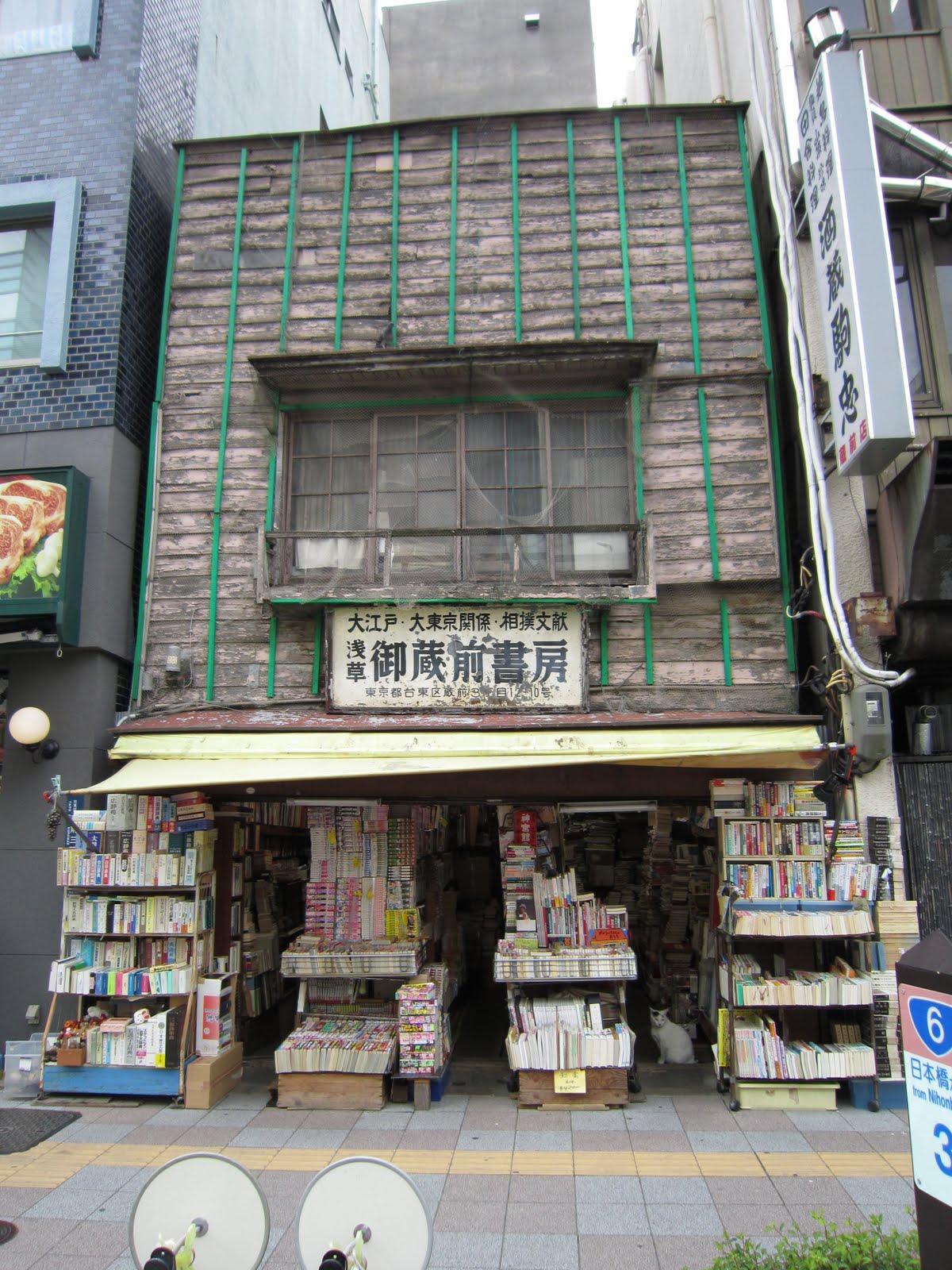
Anyway, the other day I was in the Kuramae (蔵前) district of downtown Tokyo, conveniently packing my camera, and took some happy-snaps of what is quite an inspiring older area of this city.

It's located on the west bank of the Sumida River, near Asakusa, and apparently used to be the site of the government rice granaries in the Edo period; it's still to this day a warehouse/wholesale area and there're some amazing old buildings to be found.

The area offers up a great view of the almost-finished Tokyo Sky Tree, and it turns out that, up until 1984, this was also the home of post-war sumo - namely the Kuramae Kokugikan (蔵前国技館), a building erected by the Japan Sumo Association in 1950 since the previous, bomb-damaged Kokugikan had been taken over by occupying Allied forces after World War 2.


Tournaments were held in Kuramae until September 1984, and in January 1985 the new Ryōgoku Kokugikan was opened nearby.

Kuramae still has a few interesting toy shops, smaller shrines and temples, some signposted in English, and a number of smaller shops that look unchanged since the Edo era (1603-1867) selling everything from cleaning materials to sumo-related goods.

And then there are the exceptionally old school toy shops and the book shop pictured here (see top of page).

Kuramae Station (蔵前駅) is a subway station on the Toei Asakusa Line and the Toei Ōedo Line, in case you feel like checking it out when/if you come here.


I happen to teach at a kindergarten in Kuramae on Mondays, so on this occasion wandered around a bit post-lessons.

Ace. I loved the snakes-in-a-box (right), and the area is an absolute treat.