Sunday, June 26, 2011

Monitoring the Microsieverts


I'll be the first to admit it - I'd never even heard of microsieverts, and I grew up during the Cold War, until a couple of months ago when the Fukushima Daiichi nuclear plant blew its lid post March 11 earthquake and tsunami.

Given that I live in Tokyo, we're said to be far safer than residents in Fukushima itself, since we're 230km from the ongoing fiasco. Mostly I like to believe that, but it's tricky when you harbour some suspicions about TEPCO, the owners of the plant, and just how much information the Japanese government is giving out.

Things like bunnies born without ears, irradiated tea, and YouTube clips of Geiger counter readings in playgrounds in nearby Kashiwa, here in Tokyo, do cause you to fret just a wee bit. The only thing to do is to keep a baker's dozen of eyes on all sources of info - official and hysterical - and draw a line somewhere down the middle.

That and a lucky rabbit's foot will hopefully see things through. Right?

Monday, June 20, 2011

Mutant Cherries (Japan)


When I was a kid I grew up on Marvel Comics from the '60s (sourced from my older step brother's horde) and the '70s, and via The X-Men - as well as the 1970 movie Beneath the Planet of the Apes, starring James Franciscus and Charlton Heston - I learned early that radiation causes mutation.

In the case of The X-Men the process granted them some pretty nifty powers; in Beneath the Planet of the Apes the mutants might've been able to read minds, but it seemed to me at the time that they were also bludgeoned with the ugly stick several times over.

Being a Cold War kid meant you seriously expected the end of the world to come from nuclear warfare (since there were something like seven missiles aimed at every major city in the world) and/or the radioactive aftermath.

Mother Nature was another matter entirely.

I grew up being wary of bushfire risks in Australia, and we once caught a Greyhound bus south from the Gold Coast with flames on either side of the highway, but I'm too young to remember it and my mum paints her own memory vivid.


And yet while the earthquake and tsunami here were scary tastes of nature at its most volatile, nothing really prepares you for big business gone incompetent.

These are two cherries we got in a batch as a gift yesterday from a friend.

They're sourced from the prefecture next to Fukushima, where the nuclear plant is still spewing radioactive stuff while the inept owners (TEPCO) blunder on and refuse to give clear details about very much at all - including accurate reading updates regarding the levels of caesium-137 et al that are slipping out and across the country.


The cherries are seriously deformed; it's like those three cherries on top of the TEPCO logo were sent back to DNA design school but dropped out too early.

I went cherry picking when I was 18 back in Australia and in a week of plucking the buggers I never came across anything like these. The Siamese ones are particularly striking, but my daughter says the other one, with a poking out appendage, has an eye.

Speaking of eyes, it all reminds me of the three-eyed fish from The Simpsons.

Worrisome? Hmmm. I'll get back to you on that.

Saturday, June 18, 2011

Perc Trax vs. Blank Records


Wunderbar news, this.

Two of my favourite Japanese DJ cum producers are getting together with a certain UK industrial/techno enfant terrible named Ali Wells - better known as Perc - here in Tokyo at Module on 24 June.

Ali runs the appropriately-named Perc Trax, which has been one of my preferred labels over the past few years, and I recently interviewed him for the Techno How? site.

The two Japanese guys are Jin Hiyama and his brother Go. Jin is a good mate of mine (he played at my book launch in March), and I interviewed Go a couple of months ago here.

This should be an absolutely brilliant gig; shame is that it shapes up I may not be in town to actually appreciate it...

Address: 150-0042東京都渋谷区宇田川町34-6M&IビルB1F/B2F
Cost: ¥3,000 on the door.

Saturday, June 11, 2011

Kanji Can-Can


I think it’s high time that I talked up kanji in this wayward blog.

While I’d like to assume that most people know precisely what I’m on about, I guess I should throw in a morsel for those people not so interested in things Japanese: In case you don’t know, kanji is the stuff you see on scrolls and painted in big black letters on banners – logographic Chinese characters used in the modern Japanese writing system.

Sometimes in movies you see people dabbing big brushes in ink and artily doing strokes across washi paper.

Kanji is grammatically flexible – it can twist itself into nouns and adjective and verb stems – and personally I have a delight/despair affair with the beasties. It’s a bugger to remember the thousands of characters and their various pronunciations, let alone acquire the talent to reproduce the multitude of lines.

To make things trickier, a single kanji may be used to write one or more different words, and deciding which one depends on context, intended meaning, use in compounds, and/or sentence location.

While I’ve loved the simpler Japanese katakana lettering since I was a kid (when I first saw neon Tokyo signage through the eyes of Cubby Broccoli’s film crew in the Sean Connery-James Bond flick You Only Live Twice), I’ve had a more cautious, developing relationship with kanji that probably started with Akira Kurosawa’s Ran in my early 20s.


So the funny thing is that kanji, not katakana, made such a big impact on the novel I published last month – which is based in Melbourne, Australia, not Tokyo, Japan.

The first completed treatise of what’s now known as Tobacco-Stained Mountain Goat was completed in 1992, while I was living in Richmond, an inner city suburb of Melbourne, and there was nothing Japanese about it whatsoever.

But when I moved to Tokyo in 2001, the seepage began to set in.

I wrote up a redux of the decade-old tome the following year – and thereafter again let it sit pretty, collecting dust, for the five years leading up to 2007. Then I did a major reboot, was accepted for publication through Another Sky Press in the U.S., and rewrites and editing took the better part of the next three years.

Somewhere along the line inserting kanji into the text became a big part.

As I mentioned, in 1992 there was none, not even mention of our protagonist Floyd's tattoo fuyu (‘winter’) – probably because I didn’t get it myself until 1994 in a particular winter of discontent; that’s something Floyd and I share, aside from drinks.

Likely the kanji settled itself in my brain 15 years later, after I’d watched in excess of a dozen Akira Kurosawa movies on the trot (all within one week) at the beginning of 2010.

While I do love Kurosawa and would readily volunteer myself to sit through this process another time round, there was a reason for my committed viewing: an article I was writing for Australian magazine Filmink to celebrate the centennial since the great man’s birth.


In Kurosawa films there’s occasionally kanji that dominates the screen all by itself – accompanied by a sparse, minimal score by a composer like Fumio Hayasaka or Toru Takemitsu – and it's powerful stuff even if you can’t understand what the devil it says.

So in Tobacco-Stained Mountain Goat I decided to do a Kurosawa and throw in meaningful kanji, some of which isn’t even explained in the text – meaning that anyone who scoots through this piece will have a wee bit more insight than anyone having read the book.

IF VAGUELY INSPIRED, YOU CAN READ MORE OF THIS ARTICLE @ FORCES OF GEEK.

Wednesday, June 8, 2011

AWOL: Sanja Matsuri Festival, Asakusa


'Matsuri', the Japanese word for festival, has a special meaning in this country that beats (hands down) the notion of a festival in a lot of other countries.

As my insider at anime studio Production I.G once told me, albeit sarcastically, “Japanese love their matsuri” - and he was spot on.

That affection usually doesn’t get much bigger than this: Sanja Matsuri Festival (三社祭), literally the Three Shrines Festival, in Asakusa. It's one of the three more over-the-top annual Shinto matsuri here in Tokyo... and also happens to be considered the wildest and weirdest.

Purportedly established to honor the triumvirate that set up Senso-ji, the ancient temple at Asakusa almost 1,500 years ago, the festival actually kicks off at the adjacent Asakusa Shrine on the third weekend of May, and has done so since the early Edo period (1603-1868).

That is, it usually has every year but was cancelled in 2011 as a direct result of the March 11 earthquake and tsunami up north-east, and the subsequent power supply problems (related to the travails at the Fukushima nuclear power plant) that have gripped the region.

So May came and went without any dose of this festival, and that's just plain sad.

It usually takes over the entire district, involving hordes of locals, hundreds of thousands of spectators, and a dozen or more mikoshi (portable shrines) lugged along by chanting, sweaty bearers of all ages, many of whom also happen to be members of the yazuza clad in happi jackets and exceptionally short pants.


There’s also taiko drumming, shamisen, other kinds of traditional music, performance art, a highly-charged atmosphere, beer, Ozeki One Cup saké aplenty - and geisha. Well, not quite the spectacular apprentice geisha (actually called maiko) in Kyoto, but more of a working-class, downtown, down-to-earth Tokyo variant with subdued kimonos and middle-aged lady-next-door looks.

Anyway, here's to seeing the matsuri up and running again next year, and my #1 tip for anybody planning to go: after a cursory look, steer clear of the main drags and investigate the more honestly lively side-streets instead.

Monday, May 30, 2011

Demise of a Classic Old Tokyo Manor


Two evenings ago I was walking home in the rain from Jiyugaoka Station, and spotted about 10 fire engines, a horde of people, and a huge billow of smoke that drifted up into the sky in spite of heavy rain from an approaching typhoon.

The sad fact was that a classic Taishō period (1912-26) mansion was up in flames, and the firefighters were struggling with a huge blaze that consumed a wonderful, historic wooden building.

Today I went back to see the outcome.

The photo (right) was taken just over the front gate, where a wheelchair was disturbingly left and police tape wound across the entrance. The destruction is pretty intense - the whole building is a skeleton now, with the refuse of burned telephone books, kimono, furniture, a TV, and even a coveted old reel-to-reel tape player parked on the small roof above where the front door used to be.

For Okusawa, a generally wealthy area, this is an incredibly big space. And sadly it was probably the largest old house I'd seen in Tokyo - till now.


This is the way the place was 18 months ago.

The trees surrounding the huge property made it difficult to get a decent shot from the street; I always intended to climb the wall (discreetly!) and get a couple of good photos. Now, sadly, it's too late.

I just hope the people got out of there safely.

Saturday, May 21, 2011

Yamataka Eye 山塚アイ of Boredoms


With scraggly hair and a raucous character, Tetsuro Yamatsuka (left) is not the best candidate to hustle home and greet sheltered parents.

Despite Yamatsuka’s predilection towards changing his DJ and production names, he’s best known as Yamataka Eye, and as a member of Boredoms - one of the greatest noise rock bands in a country equally renowned for Melt-Banana and Merzbow.

Formed between 1982-1986 and likely inspired by The Birthday Party and Einstürzende Neubauten, Boredoms have rotated their membership while keeping Yamatsuka in the role of front man.

Known for his atypical vocal workouts and post-production prowess, Yamatsuka was a pivotal player in the band’s most enduring album, Pop Tatari (1993), which still stands strong 18 years on.

Beyond Boredoms, Yamatsuka also recorded an EP with Sonic Youth (1993’s TV Shit), worked with Bill Laswell’s band Praxis, John Zorn’s Naked City and released two brilliant live LPs in 1995 with experimental composer Yoshihide Otomo (under the underplayed alias of MC Hellshit & DJ Carhouse).

Thrown together in disseminated ways, Yamatsuka is a rock kami unto himself—hair awry and all.

** Excerpt (my hack bit) from a Metropolis magazine article dedicated to Japanese rock gods, published yesterday - hit HERE for more.

Wednesday, May 18, 2011

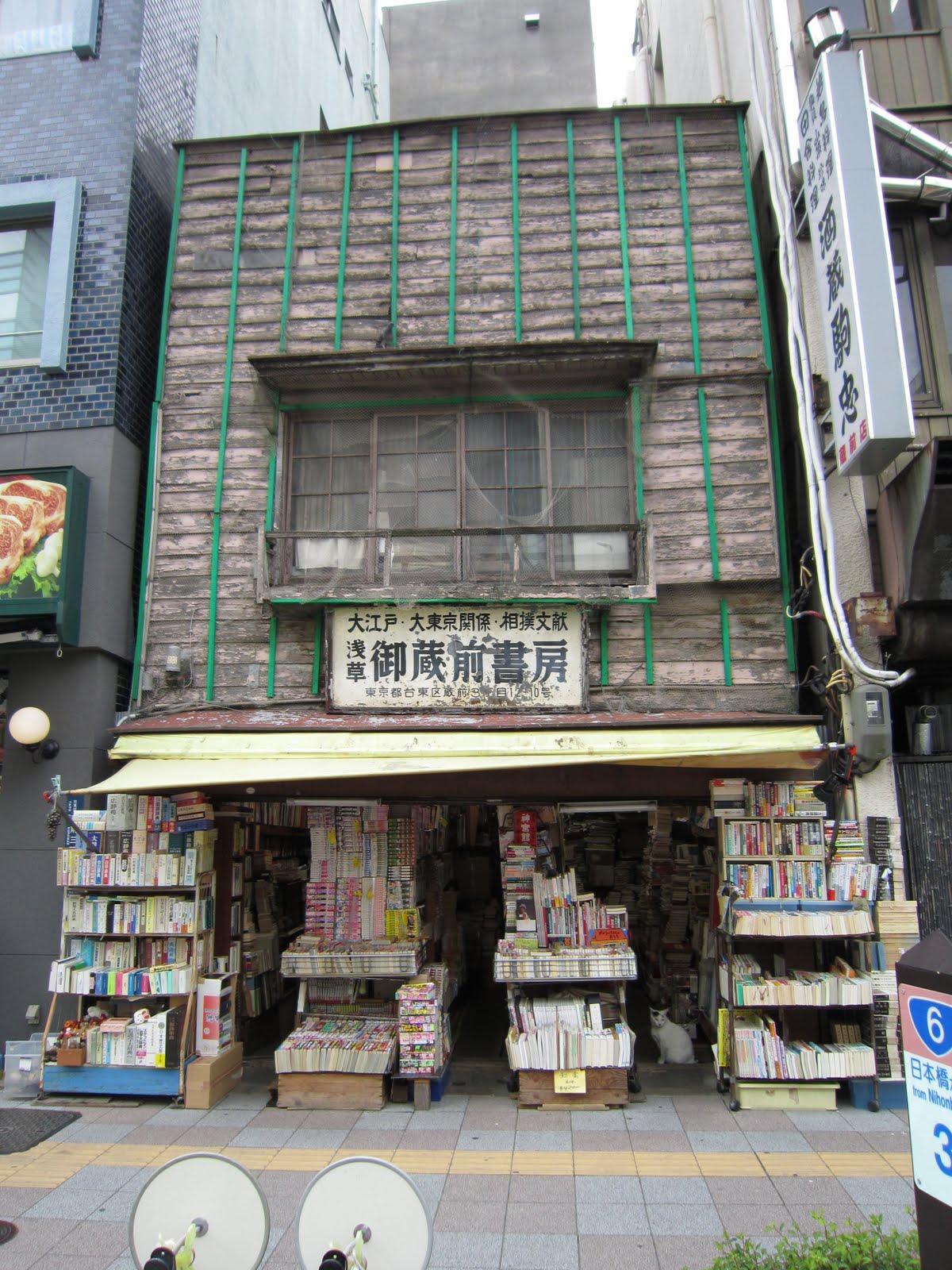
Kuramae 蔵前: Downtown Tokyo


I thought it was prime time to get off my self-indulgent corporate head-butting now that I've let off a bit of steam and come to understand these things are little more than storms in teacups in the grand scheme of things. ;)

Anyway, the other day I was in the Kuramae (蔵前) district of downtown Tokyo, conveniently packing my camera, and took some happy-snaps of what is quite an inspiring older area of this city.

It's located on the west bank of the Sumida River, near Asakusa, and apparently used to be the site of the government rice granaries in the Edo period; it's still to this day a warehouse/wholesale area and there're some amazing old buildings to be found.

The area offers up a great view of the almost-finished Tokyo Sky Tree, and it turns out that, up until 1984, this was also the home of post-war sumo - namely the Kuramae Kokugikan (蔵前国技館), a building erected by the Japan Sumo Association in 1950 since the previous, bomb-damaged Kokugikan had been taken over by occupying Allied forces after World War 2.


Tournaments were held in Kuramae until September 1984, and in January 1985 the new Ryōgoku Kokugikan was opened nearby.

Kuramae still has a few interesting toy shops, smaller shrines and temples, some signposted in English, and a number of smaller shops that look unchanged since the Edo era (1603-1867) selling everything from cleaning materials to sumo-related goods.

And then there are the exceptionally old school toy shops and the book shop pictured here (see top of page).

Kuramae Station (蔵前駅) is a subway station on the Toei Asakusa Line and the Toei Ōedo Line, in case you feel like checking it out when/if you come here.


I happen to teach at a kindergarten in Kuramae on Mondays, so on this occasion wandered around a bit post-lessons.

Ace. I loved the snakes-in-a-box (right), and the area is an absolute treat.

Saturday, May 14, 2011

Facebook: Inauthentic Name - Temporary Block


Yesterday, when I tried to log-in to Facebook, I realized I couldn't - for one of the first times in almost four years online with this social network thingy.

When I do try to log-in, I get a very interesting message.

It comes up with the enticing headline "Inauthentic Name - Temporary Block", then tells me in finer print that "Unfortunately, the name you entered was not approved by our system. Please wait 10 minutes and then try again." Having waited 15 minutes (that extra five as a buffer), I followed this sage advice, and got the same message again - this time with the warning that "Please note that if your next attempt is also unsuccessful, your account may be disabled."

I then waded through the maze that is Facebook Help, and finally discovered a portal via which to contact them, explaining that this is my real name, and not in fact inauthentic as the system now seems to believe.

I received this automated response: "Your account has been temporarily suspended because your profile does not list your real name. Facebook requires all members to provide their real first and last names."

Which is weird, because my name is Andrez Bergen, and that's the moniker I use on Facebook.

I don't remember having to provide legal proof or ID in order to first join Facebook three or four years ago, so I tested the waters on this and just went and signed up under an alias - and, hey presto! No problem. Easy as cooking boiled eggs.

Also, if they're so strict about real names being used, how come there are so many completely obvious aliases allowed on Facebook for DJs and band members? So, I read the automated email further and it says:

"Nicknames can be used, but only if they are a variation on your real first or last name, such as 'Bob' instead of 'Robert'. Which is, I guess, what 'Andrez' is - a nickname variant of 'Andrew' from when I was a teenager that I've adopted on a permanent professional basis in journalism, music and for my novel. I also have it on all my business cards - copies of which I sent through to Facebook.

This morning a real person, Pat, wrote back from Facebook but in no less automated a manner. She didn't address me personally, and added that "the only way we will be able to verify ownership of this account is if you reply to this email with an attached color image of your government-issued photo identification confirming your full name and date of birth. Rest assured that we will permanently delete your ID card from our servers once we have used it to verify the authenticity of your account."

Which prompted me to contact the Australian Embassy here in Tokyo - who strongly recommended against my sending any photo of my passport to anyone on the Internet due to concerns of fraud. I'd agree with that.

So I've contacted Facebook once again, advising this and again sending copies of my business cards to show that 'Andrez Bergen' is no sham moniker. It would be great to understand why I'm suddenly, without warning, being forced to prove my identity after more than three years on Facebook, and even when I do try to do so they decline to believe me.

All of this probably sounds like a complete waste of time (it does to me!), but I use this account not only in relation to my journalism work and for networking in business, but with friends and family on the other side of the world - who'll be even more unnecessarily worried on top of the ongoing concerns about earthquakes and the nuclear problems at Fukushima power plant.

Start from scratch with a new account?

Sounds tempting, but I put so much effort and time into the existing one, and when there's a cause to fight against a pig-headed bureaucracy, I can't help myself. No doubt I'll lose, but I'll go down fighting in an equally pig-headed manner! ;)

Wednesday, May 4, 2011

Production I.G slides out Drawer Hobs


I’ve also had a great relationship with Production I.G over the past six years or so thanks, chiefly, to Francesco Prandoni at the International Operations division.

We’d done stuff together before on Tokyo Marble Chocolate and Mamoru Oshii’s Assault Girls, and two months ago, just before the earthquake kicked this country in the stomach, I had the absolute pleasure of working again with Francesco on the English subtitles for a brand new anime feature from Production I.G.

It’s called Drawer Hobs (Tansuwarashi たんすわらし in Japanese), and what it lacks in the action/mecha quotient the story more than makes up for with a playful sense of humour and a refreshing, quirky and whimsical look at contemporary life in this city – giving even more clarity post-tremblor.

Plus it has a range of oddbod kids that reside in a chest of drawers and do such offbeat chores as checking earthquake safety (ironic), cooking up feasts, drinking beer, and wild girls’ makeovers.

But the power here is not just in the visual content or the surreal nature of the yarn – both of which are superb, by the way. It’s the real people involved here who take the venture into lofty territory.

You can read more about I.G's plans for world domination @ Forces Of Geek.


DRAWER HOBS © 2011 Kazuchika Kise/Production I.G/Japan's Agency for Cultural Affairs