Writer/director Hayao Miyazaki dabbled with plucky women in his anime previously, most notably with the character of Fujiko Mine in the Lupin III series – see The Castle of Cagilostro (1979) just for starters.
He also had younger heroines like the Pippi Longstockingesque Mimiko in Panda! Go Panda!
But in 1984, in Kaze no Tani no Naushika (風の谷のナウシカ Nausicaä of the Valley of the Wind), with Nausicaä herself – the heroine of this sci-fi/post-armageddon action/fantasy tale, and saviour of the world it chronicles – we see the tell-tale signs of female strength that invade later Miyazaki classics like Sen to Chihiro no Kamikakushi (千と千尋の神隠し Spirited Away, 2001).
The story here revolves around a world treading water (rather than on the mend) a thousand years after the apocalyptic war that’s poisoned the environment. Scattered settlements fight to survive, and one of these is the peaceful Valley of the Wind. The people here are ruled over by an ailing king and his willful, charismatic daughter Nausicaä – and all soon find themselves in a struggle not only with menacing giant insects but against militias from rival kingdoms and the threat of a return to the destructive old ways.
Amidst the action, intrigue, prophecies and surreal toxic jungle set-pieces are another couple of Miyazaki’s favourite themes: an appreciation of and support for the natural world around us, fantastic flying machines, and a huge, destructive robot.
Most Japanese people you meet will know this movie, they’ve all seen it as kids (and often as adults), and many cite it when they talk about favourite anime movies in their lives.
It’s rated in the personal Top 5 for anime director Kenji Kamiyama (Eden of the East), and Tokyo DJ/producer Jin Hiyama rates Nausicaä as his second-favourite anime movie of all time. “It’s the combination and comparison of this grotesque world with her beautiful mind and her honesty,” he raves.
It also has one of the best, most memorable soundtracks ever composed by the prolific Joe Hisaishi (Hana-bi). I've lost count of how many times I've heard little kids and their parents humming the iconic theme music.
Still, there are some important things to keep in mind when it comes to Nausicaä.
For starters the earlier manga series (also by Miyazaki) is a far more comprehensive and telling journey.
“You must read the manga,” urges musician Lili Hirakawa. “While the movie is great, it doesn’t tell you nearly enough about this world."
Additionally, this ground-breaking movie originally entered the West back in the ‘80s via a badly dubbed and horrendously edited version on VHS called Warriors of the Wind – an excruciating cut that makes little sense and a bitter learning curve for both Miyazaki and Studio Ghibli, who've since insisted on a “no edits” overseas licensing clause.
The edits, however, have nothing on the cover.
That art (left) from the video cassette didn't even feature principle character Nausicaä at all - save for that lame ring-in in the top right-hand corner. Instead the foreground is dominated by a trio of males characters I'm pretty certain aren't in the film at any point, not even closeted away driving the tanks.
Fortunately an uncut and re-dubbed DVD version of Nausicaä of the Valley of the Wind, with (even better) the original Japanese dub and good English subtitles, became available around the world in 2005, although I picked up my copy earlier on from Studio Ghibli here in Japan.
And the verdict on the ‘real’ version, in spite of the disclaimers? Quite simply brilliant - just avoid that VHS predecessor at all costs.
"Versus was the movie that changed my life and it means everything to me. The spirit of it is pure me and that's why it was so special. Fight your destiny, find out who you are, fight through to the end for your love; it ain't over till it's over... That theme and message came from within me."
So assesses Ryuhei Kitamura in a moment of absolute clarity.
These moments are peppered right throughout any interview with the Japanese director; far from being a scatter-logical talking head or playing things close to his chest with a bunch of guarded one-word answers, like some of his more famous brethren, Kitamura unfurls things freely and easily and occasionally hits home with these moment-of-certainty comments.
Versus (2000) was Kitamura's big breakout movie, a canny combination of action and horror that in many ways has served to define or at the very least delineate his work since.
"It's all me," he agrees. "It's all Ryuhei Kitamura-style, and I'm not going to try to change or steer away from anything. I'm only trying to get better." Versus, it becomes clear, was an apotheosis in Kitamura's career; a punctuation mark he always tends to refer to for its apparent sense of purity in his cinematic vision.
"When I was making it exactly ten years ago I hadn't even started off my career properly, I had no money, and a very murky future. But somehow I had faith in myself, and all the cast and crew believed in me and gave me the incredible courage to finish it."
Kitamura pauses for just a moment.
"I don't know how I survived two years of making the film, but somehow I did and here I am now. Versus is me. It was the very beginning, and now there will be a new Versus. It's part of my life and I can't escape that."
The new Versus he's talking about is Versus 2, which is already listed on imdb.com but the director admits he hasn't actually started it yet.
"This year [2010] will be tenth anniversary year of Versus so I'm thinking of doing something special. The original film means a lot to me and has huge fans all over the world, so I can't do anything easy or cheap - I can't guarantee anything in the long run, it's a definite that I'll do the new Versus in the future for sure."
At the moment Kitamura says he's in post-production on Shadows, a movie he's producing rather than directing. "It's a supernatural horror takes place in Thailand, and I'm working with writer/director John Penney and stars Cary Elwes and William Hurt. I'm producing many projects now."
On top of this Kitamura is also in pre-production on a movie he's going to direct that's called Taekwon.
"It's my version of The Karate Kid and it takes place in Korean Town in Osaka, Japan. It's the story of a Japanese street-fighting kid who meets a Korean taekwondo martial arts expert. I wrote the script and am producing the movie now; we start shooting this spring."
Just over five years ago Kitamura had wrapped up the final installment in Japan's longest, most misunderstood cinematic franchise, when he helmed Godzilla: Final Wars in 2004.
It was somehow equally appropriate that Kitamura's style and intent on the finale was equally misunderstood in some quarters.
The critical reaction was a startlingly mixed bag, as reflected in the movies 50% rating on rottentomatoes.com, with some calling it 'A rush of explosive excitement' (Cinefantastique) and others claiming it focused too much on action and not enough on story (Boston Globe).
Personally I loved everything about Final Wars - it was all too apparent that it'd been made by a fellow old-school aficionado of the humble kaiju (Japanese monster) movie.
Kitamura himself recalls the experience with obvious relish. "It was great!" he enthuses.
"I mean, it was Godzilla. It was the 50th anniversary. And it was the final movie. Who could say no? It was a once-in-a-lifetime opportunity and I had a great time making it and am very proud of the movie. I even decided to use the old fashioned man-in-rubber-suits style and it was pure fun - think big explosions and motorcycle chases, and I even got to shoot a few scenes in Sydney, where I'd learned film making in the first place. Lots of great memories."
Final Wars was the 28th Godzilla movie - so it's pertinent to know whether or not the director sat through all the previous 27 films before shooting his own.
"Yeah, I did," Kitamura confirms.
"In fact I loved the Godzilla movies back in the '70s, but not so much the ones released in the 1980s and '90s. Godzilla movies back in the '70s were never just monster movies... There were always messages and themes that reflected the time and world within which they were made, and they combined this so well with straight-out entertainment. They lost that touch in the '80s. I'm an honest guy and that's what I told the producer in the first meeting. Strangely, the producer liked what I said and I was hired to do something that was not only new, but also classic in a sense."
So is the kaiju movie still alive and well in Japan in 2010?
"I don't think so. These days, Japanese film studios are only interested in making dramas based on novels, manga or another TV series. Nobody wants to do expensive, old-fashioned kaiju movies. For me, the beauty of the kaiju movie is the retro man-in-rubber-suits style, not CG; it has more soul. Godzilla: Final Wars was the last movie made in that style. I'd be more than happy to revive the tradition in the future and do a new kaiju movie."
Kitamura has previously let it be known that his favourite kaiju character is King Caesar, who first appeared in Godzilla vs. Mechagodzilla in 1974 - then reappeared 30 years later in Final Wars.
"I simply love that original Godzilla vs. Mechagodzilla movie," says the director. "The moment King Caesar wakes up is my favourite moment in all of the Godzilla movies. It was so hard to choose which monsters would be in Final Wars - everybody has their favourite, and unfortunately we couldn't put them all in. So some tough choices had to be made."
Some foreign audiences know Kitamura best for Azumi (2003), a film that turned out to be an energetic, sometimes touching, and definitely underrated action set-piece that was dubbed ninja J-pop by one reviewer.
"It was my first big movie, based on a manga comic that was a huge influence in my own style," he muses.
"It took me two long years from start to end; I put all my energy into it and I'm so proud of it. The producer, Mata Yamamoto, hired me after he watched Versus. That was back when I was a complete nobody, and he gave me the big break and also believed in me. I was an angry, young, reckless director, and we had so much fun and a lot of fights making that movie."
It turns out that the original manga, by Yu Koyama, was a pivotal factor in Kitamura's own development as an artist and filmmaker.
"I grew up reading the great comics of Yu Koyama. He was my favourite comic author, so I was extremely happy when I got this job [to make Azumi], but also it created an unbelievable sense of pressure because I loved the comic so much. Then again, I realized that I understood the spirit of Azumi better than any other director, so I was 100 percent confident that I was the right one to accomplish the mission."
Joe Odagiri's turn as the effete killer Bijomaru Mogami is as funny as it is eerily scary - it turns out like an amalgam of British vocalist Morrissey's live performance tic in the '80s (when he inanely tossed flowers into the crowd) blended with Ben Kingsley, in Sexy Beast mode, dressing up as Boy George.
"The original comic series is really long - there are something like 48 volumes, a huge story arc, and tons of characters - so it was very difficult but really important to choose which episode and which character to incorporate. I thought about it again and again and created an original story for the movie, and for that chose Bijomaru for the main enemy. I think I made the right choice, and Joe Odagiri did a fantastic job."
Some of the criticisms of Azumi were that it was too violent, especially given the laid-back, somewhat zany nature of the opening part of the story. By the end, with Azumi herself drenched in blood and most of the principle characters dead, the scenario could be seen as quite bleak.
"I agree, and that's what I wanted to do. It's easy for me to make movies without blood or violence, but Azumi wasn't that kind of movie," Kitamura says.
"The whole concept was about war, life, death and terrorism. I never agree that having violence in a movie is a bad influence on kids. F**k no. It's not a f**king videogame," he asserts.
"Not that I mean anything against video games; I love them. What I mean to say is that kids shouldn't feel that killing is just like playing a video game. I was making a live-action movie, and Azumi was serious - not like more fun movies Versus or Midnight Meat Train. Azumi had to feel real and painful when she's killing somebody."
Kitamura puts it another way: "If you cut someone... it hurts, and blood comes out, and that's what the audience should feel.
"With this movie I couldn't go into a clean, sterile safety zone. I know if I took out the violence and thus avoided the ratings issue, and maybe cut out 20 minutes to make it a two-hour movie, it would've been a much bigger hit - but I just couldn't do that. I had to do the right thing for the story. That's the most important thing for me. Violence and length were the two big issues I had to fight about all the way through. I'm just glad I had the strength to fight till the end, and kept the movie I really wanted it to be."
Azumi was also actress Aya Ueto's big break, and she shone in the pivotal title role.
"We met more than 150 beautiful actresses and couldn't find our Azumi," Kitamura recalls.
"One day I saw Aya on a local poster for a baseball campaign, and I instantly knew that it was her. She was an absolute nobody at that time and I had to fight against everyone else to cast her. I only feel respect and love for Aya - she's a wonderful girl and an amazing actress. We did a new animation movie together called Baton this year," for the City of Yokohama 150th anniversary celebrations.
When I ask for Kitamura's opinion on this sequel, he responds with another of those moments of clarity I mentioned.
"I don't want to answer this question. The fact that there was never an Azumi 3 is the answer. I have nothing against Mr. Kaneko - he's been a great supporter of me since Versus. But I don't want to even think about Azumi 2."
Which brings us full circle to how he actually first got started making movies.
"I grew up watching movies back in the '70s and '80s - Hollywood, Japanese, Australian, Italian; action, horror, sci-fi, drama... everything!" He laughs. "I spent most of my time in cinemas and didn't go to school much. Movies were instead my school, my teacher, my life.
"When I was 17, I started thinking about my future and it was natural for me to decide that I'd become a film director. It all started as my fantasy, my own imagination, and I could make that real... That's the best thing about movie making. So I promptly quit high school, went to Australia, and entered film school. That was the beginning."
Why Australia?
"For simple reasons. Mad Max, director Russell Mulcahy, and INXS, all of these together conspired to make me go Down Under.
"I wasn't great student at school, I was poor, but those were happy days for me. From 1987 to 1989 I went to the School of Visual Arts in Sydney, I lived in Paddington, Rose Bay and North Sydney. I love Australian movies and Australian rock - not only INXS but also James Reyne, Jimmy Barnes, Icehouse... I still love them."
Citing favourite international film directors is deceptively easy - "James Cameron, George Miller, Peter Weir" - but when it comes to chalking up a list of preferred fellow Japanese directors, Kitamura stumbles.
"That's a tough question to answer. There have been too many great directors in Japan, and I can't pick just one or two," he then sighs.
"However, that said I feel bad that I can't find so many directors that I respect in Japan these days. But if I had to choose just one... I'd say Shunji Iwai [Fried Dragon Fish]. I really admire his talent and highly respect him. I think Swallowtail Butterfly [1996] is one of the most original and beautiful Japanese movies ever made."
Finally, as per a recent interview bent, I just have to ask Kitamura what he thinks is the most offbeat place in Tokyo. Interestingly enough, he opts out of the city altogether.
"Tokyo is a boring city," he asserts.
"I love my hometown, Osaka. I think it's Latin Japan - totally different from Tokyo, more funky, more crazy, and more sexy."
To get you in the mood for Versus 3, here's the trailer for the one that started it all a decade ago:
Starting out in 1987 in the otaku paradise that is Nakano Broadway, in West Tokyo, manga and anime merchandisers Mandarake have conquered the rest of Japan and these days have stores across this metropolis – in Shibuya, Akihabara and Ikebukuro – as well as in other essential cities like Osaka, Fukuoka, Nagoya, and Sapporo.
While they’re up against stiff competition in the manga and anime market from the likes of the Animate chain, Mandarake also specializes in second-hand and old school, priceless, and sometimes obscure paraphernalia, not just from Japan, but from around the rest of the world – which accounts for the fact that a manga comic book signed by Osamu Tezuka in 1977 (retailing for ¥200,000 and protected behind glass) was, a couple of years back, sitting right nearby a lonesome Grand Moff Tarkin doll (based on the devious Death Star commander played by Hammer Films regular Peter Cushing) from Star Wars: Episode IV that same year... collecting dust in a bargain bin and selling for just ¥200.
Man, I wished I'd picked that baby up (the Grand Moff, I mean) - but as it is I did end up with a buy from Mandarake's bargain shelves that stumped me at the time, and still does: An Australian O.D.F. soldier I had no idea about that was released in the 1996 G.I. Joe Classic Collection. It was reduced from ¥6,900 to just ¥600, with a bigger layer of dust than that of the aforementioned Star Wars villain.
As Jessie, the Yodeling Cowgirl is wont to say, he was mint in the box, never been opened; if Australian militia types really did dress like this furrowed-brow chappie, our country would be an international uniform designers' laughing stock.
The spiel on the box of this fellow Aussie is likewise hilarious.
"Founded in 1982 after the invasion of the Falkland Islands," it claims, "the Australian Operational Deployment Force (O.D.F.) is highly skilled in quick reactions, often deploying to a location ready for action without any prior notice, regional force surveillance units to understand any situations they face. Wearing the traditional uniform of plain khakis, slouch hat and boots, and armed with an FN FAL 7.62, a Russack, personal equipment belt, pouches and a canteen and holder, the G.I. Joe Australian O.D.F. is ready for action."
I'm fairly certain most of my 21 million compatriots haven't heard about these elusive individuals nor their debonair exploits either, though there's actually some guff about the real-life Operational Deployment Force here... Far less convoluted in their intention and founded two years before the Falklands.
Also available from these incredible stores are lovely tin toys from the 1950s, original animation cels from just about every series you can think of, cosplay outfits, CDs, DVDs, art-books, giant robots the size of you or me and even a wee bit bigger, and anything else obsessive-compulsive-collector related.
Essential one-stop shopping for any anime or manga aficionado, plus other people besides.
It seemed somehow fitting when, in late May 2008 at the 12th Seoul International Cartoon & Animation Festival (SICAF 2008), a charming, quirky little anime feature titled Tokyo Marble Chocolate was awarded the Grand Prize in the Feature Film Category.
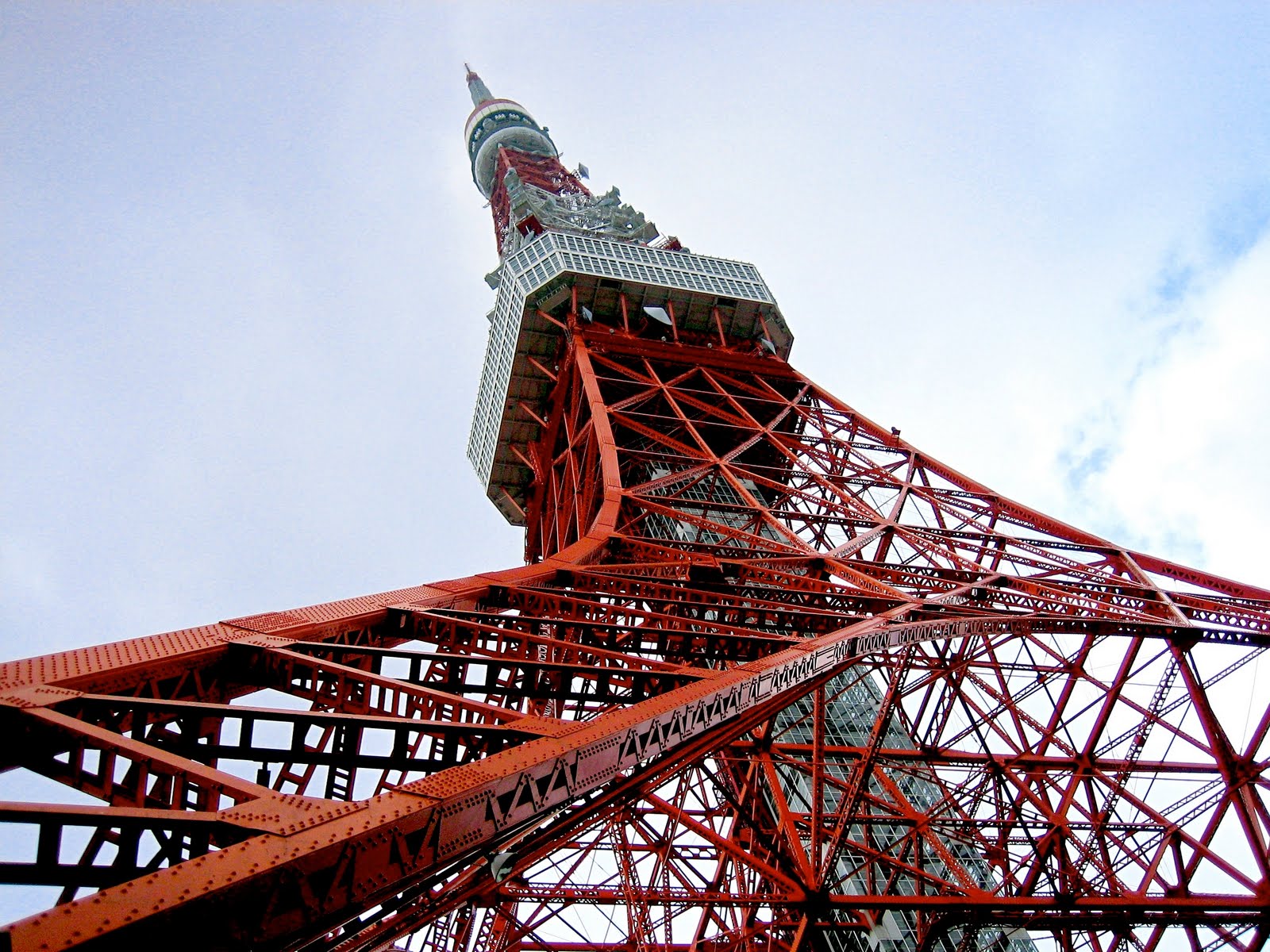
After all, much of the anime’s unfolding romantic comedy and poignant philosophizing about love and life in contemporary Tokyo takes place around Tokyo Tower – an obelisk that in 2008 also celebrated its 50th anniversary.
While there are a lot of other symbols of Japan that weigh in much older and further tip the scale in the history stakes, when you're debating the preeminent visual icon in Japan's capital city, and its more famous ones, you can’t possibly ignore Tokyo Tower.
Besides, it’s impossible to miss the tower – painted, as it is, in vivid red and white and gorgeously spot lit after hours. Stature-wise, it reaches upward to a peak of 333 meters, thus edging out its earlier doppelgänger, the Eiffel Tower, by around nine to 13 meters, depending on whether or not you include their antennas in the equation.
Tokyo Tower also continues to dominate the skyline as the world's tallest self-supporting steel tower, easily seen from the Imperial Palace and Roppongi. It boasts an otaku-revered antenna that broadcasts all that vital anime we watch on TV stations here in Tokyo like NHK, TBS and Fuji TV.
The past 50 years have been quite remarkable, and monumental unto themselves in terms of the life of this tower and its impact on this city as well as Japan and the outside world.
It dominates the back-drop in the recent, nostalgic feature movies, Always: Sunset on Third Street, parts one and two, that were directed by Takashi Yamazaki (of Returner fame) and set in the late 1950s, during the tower’s construction. And our metallic altar was used as the titular name of a movie in 2005 that starred Junichi Okada, who more recently did the voice of Prince Arren in Studio Ghibli's Tales from Earthsea.
In contrast to such dramatic attention, however, the tower has long been Godzilla’s and Mothra’s favoured plaything, and in manga has been particularly ill-treated: it was sucker-punched in Geobreeders, became the center of paranormal activities in the pages of Tokyo Babylon, and was the focus of some alcoholic excess in Wings of Wishes.
The tower also features heavily in anime.
It was shown destroyed in Cybuster, then popped up in a more romantic light – before being partially ransacked – in Sailor Moon, as well as in other anime like Card Captor Sakura, X, Magic Knight Rayearth, Angelic Layer, Someday’s Dreamers, and Burn Up Excess.
In fact if the anime outings are to be believed, the structure is actually a magnet for mayhem and a portal for inter-dimensional mysticism.
All the iconoclasm may be fictional, but the tower came a hair’s breath from destruction in September 2004, when a 747 accidentally passed within 200 meters, en route to Haneda Airport.
And yet, while the monument may have been crushed, squashed, melted down, transformed, and manhandled like a mammoth toothpick, and represent an object of some cynicism in younger Japanese’s minds, Tokyo Tower wasn’t raised for ruin alone.
Twenty-something Japanese English language school advisor, Shoko Shima, sees the tower in a more positive light. “For me, Tokyo tower is one of the symbols of Tokyo. When I see it, it makes me feel nostalgic. It’s not cute, nor interesting, but I think we need it in Tokyo as an older symbol of the city.”
And acclaimed electronic music producer, Toshiyuki Yasuda (Robo*Braziliera), says that “It is most assuredly a romantic symbol in mid-Tokyo.”
The obelisk was designed by Nikken Sekkei Ltd., and constructed in 1958 by Takenaka Corporation, Japan's oldest architecture and engineering and firm, at a cost hovering at around ¥2.8 billion.
It has an average 2.6 million visitors per annum and has been romantically illuminated at night – with 164 globes that change color according to the season – for enamoured young and old couples alike since 1989. Many of them visit the first-floor aquarium, which houses some 50,000 fish, or the wax museum on the third floor, and then the self-explanatory Trick Art Museum. The view itself is an optional extra.
On a clear day, Mt. Fuji is visible from the tower. On most days, unfortunately, it isn't.
Regardless, all this is set to end in a way when Tower Tower is superseded by its younger, more virile replacement, the Tokyo Sky Tree – currently being constructed in Sumida (see below, this week) - which aims at almost twice the size of our existing aging hero.
Turns out that Tokyo Tower just isn't tall enough in the 21st century to offer complete digital terrestrial television broadcasting coverage - but at least this may mean that Ol' Red will be left in a secure retirement from attacks by Godzilla and his kaiju cronies.
The Tokyo Sky Tree will just have to lean to deal with the abuse.