Showing posts with label tower. Show all posts

Saturday, October 9, 2010

The HAL 9000 Building


Mode Gakuen Cocoon Tower (モード学園コクーンタワ) is a relatively new building in Shinjuku that I've been passing nearby for months on the way to work, but I only got around to taking some happy snaps of the place the other day.

Better known to me as the HAL 9000 building because it houses HAL Tokyo, a special technology and design college (and it just looks so darned "designer modern", like something that'd be right at home in 2001), the Cocoon Tower was actually completed 2 years ago, designed by Tange Associates, the company set up by famous architect Kenzo Tange.

As far as facts and figures go, the 204-metre-tall (669 ft), 50-storey tower is apparently the second-tallest educational building in the world. I think the highest building I set foot in at Melbourne University clocked in at five storeys, which is a wee bit shorter.


Mode Gakuen Cocoon Tower is currently the 17th-tallest building in Tokyo - and it won the Kewpie Doll when it was awarded the 2008 Skyscraper of the Year by Emporis.com.

It certainly gets this wayward blog's nominations as well.

While it does stick out like a sore thumb directly outside the West Exit of Shinjuku JR Station, it's the kind of aching digit you're more than happy to put up with.

I guess we could throw in the old punchline here about suffering for art.

And speaking of HAL 9000, here he is for a bit of nostalgia's sake.

Monday, November 30, 2009

Tokyo Tower vs. Tokyo Sky Tree!


It seemed somehow fitting when, in late May 2008 at the 12th Seoul International Cartoon & Animation Festival (SICAF 2008), a charming, quirky little anime feature titled Tokyo Marble Chocolate was awarded the Grand Prize in the Feature Film Category.

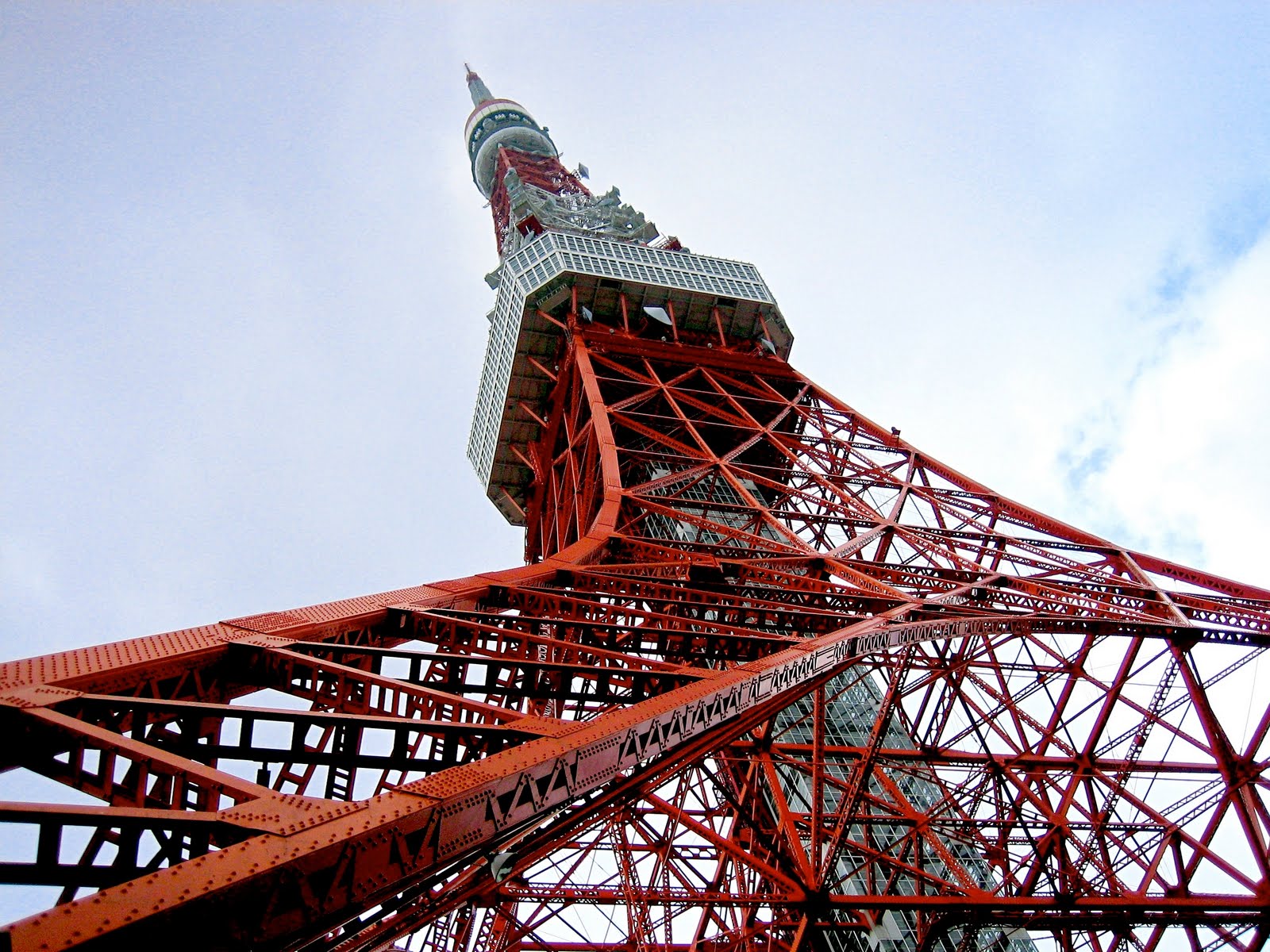
After all, much of the anime’s unfolding romantic comedy and poignant philosophizing about love and life in contemporary Tokyo takes place around Tokyo Tower – an obelisk that in 2008 also celebrated its 50th anniversary.

While there are a lot of other symbols of Japan that weigh in much older and further tip the scale in the history stakes, when you're debating the preeminent visual icon in Japan's capital city, and its more famous ones, you can’t possibly ignore Tokyo Tower.

Besides, it’s impossible to miss the tower – painted, as it is, in vivid red and white and gorgeously spot lit after hours. Stature-wise, it reaches upward to a peak of 333 meters, thus edging out its earlier doppelgänger, the Eiffel Tower, by around nine to 13 meters, depending on whether or not you include their antennas in the equation.

Tokyo Tower also continues to dominate the skyline as the world's tallest self-supporting steel tower, easily seen from the Imperial Palace and Roppongi. It boasts an otaku-revered antenna that broadcasts all that vital anime we watch on TV stations here in Tokyo like NHK, TBS and Fuji TV.

The past 50 years have been quite remarkable, and monumental unto themselves in terms of the life of this tower and its impact on this city as well as Japan and the outside world.

It dominates the back-drop in the recent, nostalgic feature movies, Always: Sunset on Third Street, parts one and two, that were directed by Takashi Yamazaki (of Returner fame) and set in the late 1950s, during the tower’s construction. And our metallic altar was used as the titular name of a movie in 2005 that starred Junichi Okada, who more recently did the voice of Prince Arren in Studio Ghibli's Tales from Earthsea.

And just two years ago the movie Tokyo Tower: Mom and Me, and Sometimes Dad, starred the very cool Joe Odagiri (Shinobi).

In contrast to such dramatic attention, however, the tower has long been Godzilla’s and Mothra’s favoured plaything, and in manga has been particularly ill-treated: it was sucker-punched in Geobreeders, became the center of paranormal activities in the pages of Tokyo Babylon, and was the focus of some alcoholic excess in Wings of Wishes.

The tower also features heavily in anime.

It was shown destroyed in Cybuster, then popped up in a more romantic light – before being partially ransacked – in Sailor Moon, as well as in other anime like Card Captor Sakura, X, Magic Knight Rayearth, Angelic Layer, Someday’s Dreamers, and Burn Up Excess.

In fact if the anime outings are to be believed, the structure is actually a magnet for mayhem and a portal for inter-dimensional mysticism.


All the iconoclasm may be fictional, but the tower came a hair’s breath from destruction in September 2004, when a 747 accidentally passed within 200 meters, en route to Haneda Airport.

And yet, while the monument may have been crushed, squashed, melted down, transformed, and manhandled like a mammoth toothpick, and represent an object of some cynicism in younger Japanese’s minds, Tokyo Tower wasn’t raised for ruin alone.

Twenty-something Japanese English language school advisor, Shoko Shima, sees the tower in a more positive light. “For me, Tokyo tower is one of the symbols of Tokyo. When I see it, it makes me feel nostalgic. It’s not cute, nor interesting, but I think we need it in Tokyo as an older symbol of the city.”

And acclaimed electronic music producer, Toshiyuki Yasuda (Robo*Braziliera), says that “It is most assuredly a romantic symbol in mid-Tokyo.”

The obelisk was designed by Nikken Sekkei Ltd., and constructed in 1958 by Takenaka Corporation, Japan's oldest architecture and engineering and firm, at a cost hovering at around ¥2.8 billion.

It has an average 2.6 million visitors per annum and has been romantically illuminated at night – with 164 globes that change color according to the season – for enamoured young and old couples alike since 1989. Many of them visit the first-floor aquarium, which houses some 50,000 fish, or the wax museum on the third floor, and then the self-explanatory Trick Art Museum. The view itself is an optional extra.

On a clear day, Mt. Fuji is visible from the tower. On most days, unfortunately, it isn't.

Regardless, all this is set to end in a way when Tower Tower is superseded by its younger, more virile replacement, the Tokyo Sky Tree – currently being constructed in Sumida (see below, this week) - which aims at almost twice the size of our existing aging hero.

Turns out that Tokyo Tower just isn't tall enough in the 21st century to offer complete digital terrestrial television broadcasting coverage - but at least this may mean that Ol' Red will be left in a secure retirement from attacks by Godzilla and his kaiju cronies.

The Tokyo Sky Tree will just have to lean to deal with the abuse.

Friday, November 20, 2009

Tokyo's Postmodern Purge


One of my preferred sci-fi flicks from the early ‘50s is The Thing from Another World, with James Arness menacing a crew of American military trapped on an
Arctic base. The direction, while credited to Christian Nyby, smacked more of Howard Hawks’ style — and while Hawks is listed in the credits just as a producer, people do have their doubts.

Anyway, my lasting memory of the movie is the final paranoid riposte, “Watch the skies, everywhere! Keep looking. Keep watching the skies!”, and the truth is that in Tokyo, you really do always have to look heavenward.

It’s a lesson I thought I’d learned after I first arrived in this city and cottoned on that some of the coolest cafes and record shops are tucked away on the sixth or seventh floors of inconsequential skyscrapers.

But I think a recurrent crick in the neck negated Ned Scott’s warning in recent years, and my gaze had fallen back to ground-floor level—that is, until I stumbled across an article, in the oft indispensable, Tokyo-based English language lifestyle magazine, Metropolis, that reported on buildings slated to be condemned in this self-reinventing city of flux.

As it was, I already knew about Minoru Takeyama.

He’s one of Japan’s more famous architects, a Waseda and Harvard graduate, as well as a professor, author, and innovatory thinker; the man even worked at one stage in the early ‘60s with Arne Jacobsen, deviser of the seriously pricey Series 7 chair.

Takeyama is best known here for the landmark Ichi-maru-kyu (109) building in Shibuya, erected in the late ‘70s — but a decade before, in his mid 30s, he’d conjured up a couple of far more iconic towers in Kabukicho, a few minutes’ walk from Shinjuku Station, and thereby created some of the earliest examples of Japanese architectural postmodernism.


It’s these, rather than the 109, that give Takeyama kudos in architectural circles in the West, and what I didn’t know was that I’d passed these buildings by on several occasions, without ever noticing. It wasn’t until the Metropolis piece that I got the heads-up, realized my error, and started watching the skies again.

Once you do raise your eyes from the garish thrall of the surrounding men’s host clubs, you get to see the pop art colors of Nibankan (Number Two Building, 1970, above), which looks like Roy Lichtenstein had a hand in the palette, and the monochrome, superbly Gigantor-styled Ichibankan (Number One Building, 1969, pictured at the end of this article).

Both buildings have, however, seen far better days.

They’re now bereft of tenants (Ichibankan completely so) and in disrepair, while the owners — apparently love hotel and business accommodation operators, Sankei Hotel — act suitably indifferent.

“The buildings are in a terrible state,” Takeyama told me for this article, which was recently published in Geek Monthly over in the US. “My understanding is that the my client sold the ownership to an entertaining company rather recently. I have no contact with the new owner, and just wish that they preserve the buildings.”

One senses Sankei are biding their time, and the buidings themselves are just waiting to be demolished — as is the Nakagin Capsule Tower in Ginza (below), right near Shinbashi.

A mesmerizing structure that deigns to juggle some 140 boxes (modified containers that vary in size, depending on the source material you check, but around 4 x 2.5 meters), stacked at angles on 14 tottering floors, this was the first ‘capsule hotel’ per se — designed by architect Kisho Kurokawa, and constructed between 1970-72.


Kurokawa had previously helped to found the Japanese Metabolism Movement in 1959, an architectural group equally philosophical in tone, with an eye on technological advances; they envisaged a futurist city whose principle structures would be flexible and encourage an organic growth potential.

Ten years later, Kurokawa apparently conceived of the Nakagin Capsule Tower while abiding by the maxim of “metabolism, exchangeability, and recyclability”.

Truth is, though, that I’m not quite sure what two of these ideas entail, nor how they relate to this rather cool building that’s slowly crumbling away due to overt lack of maintenance.

Apparently the designer was into the idea of replacing the capsules where necessary (hence the ‘exchangeability’, which is the bit I’m blessedly able to nut out), but nobody’s ever bothered to follow through, and the structure is now quite visibly on its last legs.

Ironically, while the Nakagin Capsule Tower was originally under construction, Minoru Takeyama was busy setting up the group ArchiteXt (long before the founders of Excite started using the same moniker—sans the big ‘X’ — for their new-fangled Internet portal in 1994) — to counter the Metabolist ideals that Kurokawa espoused; they instead they cited equally dizzying concepts like contradiction, discontinuity, individualism, and pluralism.

The fate of both divergent schools of thought seems to have been pretty much the same.

Like Ichibankan and Nibankan, the Nakagin Capsule Tower is overdue for demolition, in this case due to reported fears of use of asbestos in the construction, as well as concerns that it’s not an earthquake-proof building.

Coupled with the costs of making structures seismically-sound and attractive to an aging clientele forever interested in things new, developers in Tokyo place precedence on the wrecking ball rather than on landmark properties that’re getting a wee bit long in the tooth.

You get the impression that all three buildings are blocking the path of funkier, newfangled residential crystal palaces — while the government certainly hasn’t wasted a lot of time considering notions like artistic architectural heritage and its preservation for future generations.

It’s an impression that Takeyama agrees with 100%, and he also stresses local ignorance. “Both of my buildings are recognized among foreign architects, but not known domestically in Japan,” he says.

So, when this combination mindset takes its natural course, I might as well ditch the sage advice from The Thing from Another World, and stop watching those skies after all.